
 By Global Arena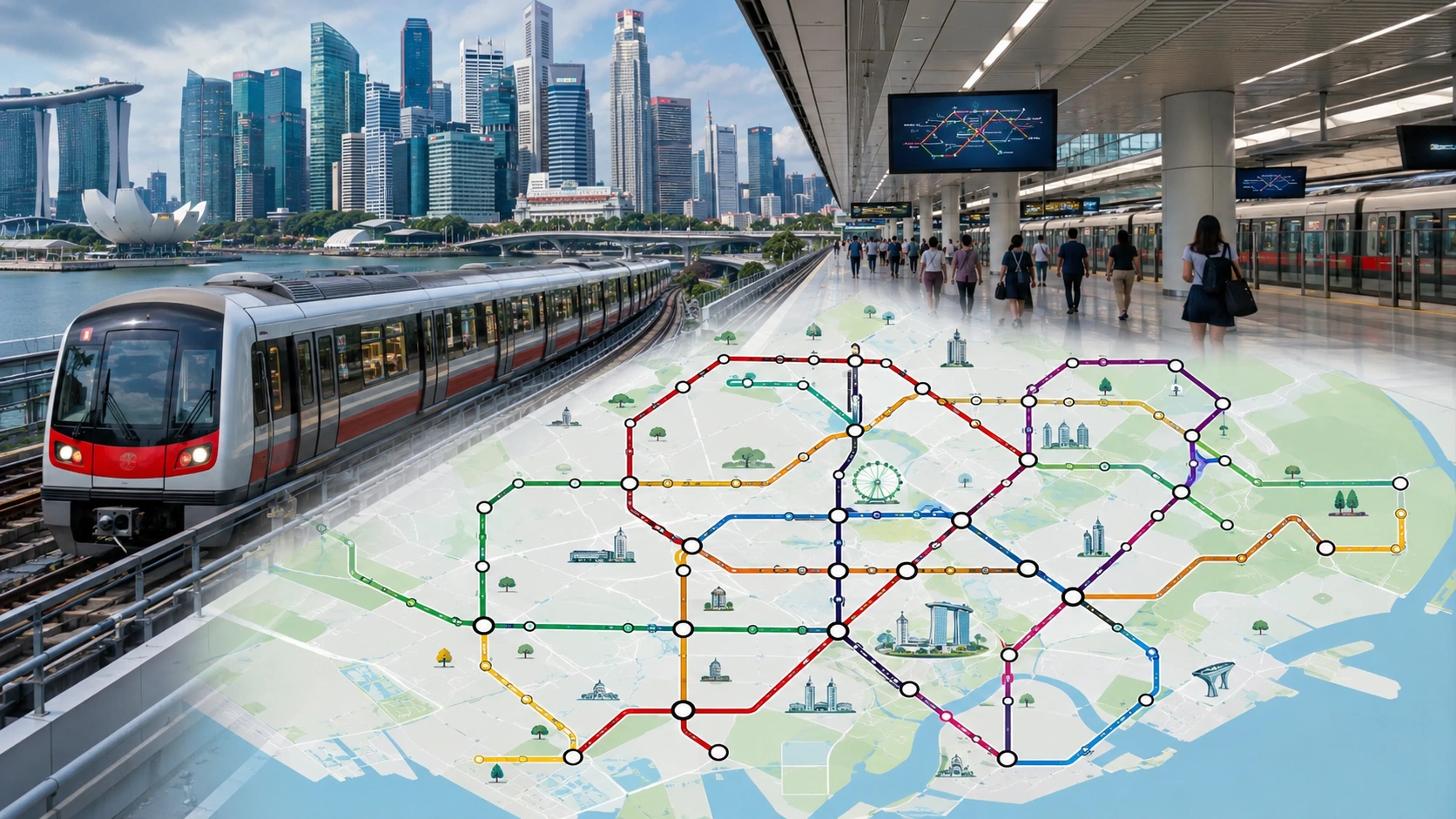
Singapore MRT is the backbone of Singapore public transport, connecting residential areas, business districts, shopping streets, tourist attractions, and Changi Airport. For visitors and residents, knowing how the Singapore MRT network works can make daily travel much easier. The network includes multiple MRT lines, hundreds of stations, and key interchange points where passengers can change trains to reach different parts of the island.
This MRT Network Guide Singapore covers the main MRT lines Singapore, important stations, interchange points, routes, fares, operating hours, and airport connections. It also explains how to read the Singapore MRT map, plan a journey, and choose useful stations for popular places such as Orchard Road, Marina Bay, Chinatown, Sentosa, and Gardens by the Bay.
Whether you are using the MRT for the first time or want a clearer understanding of Singapore’s rail network, this guide gives you the practical information needed to plan your trips with less confusion.
Singapore MRT Network at a Glance
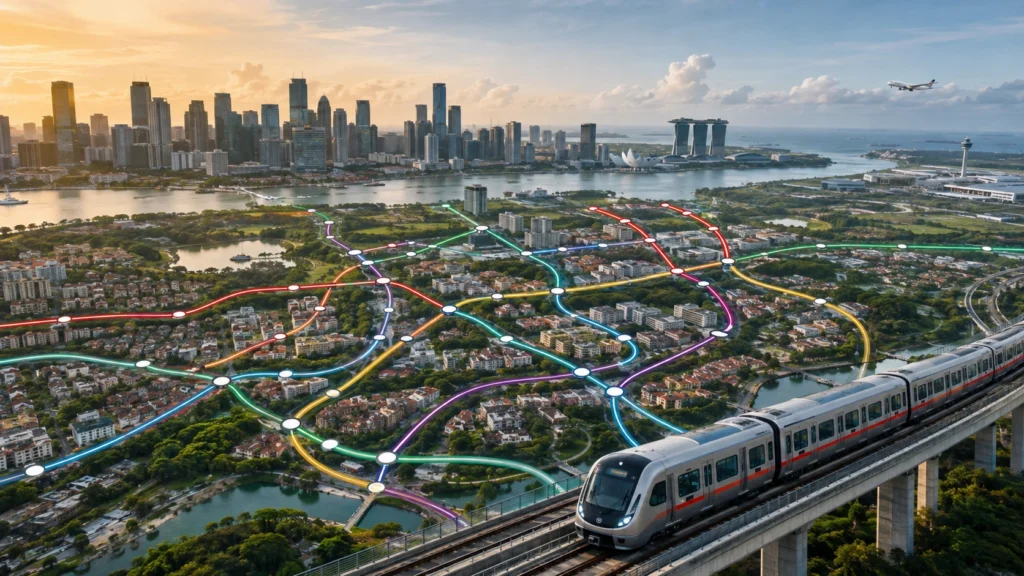
The Singapore MRT network is the main rail-based part of Singapore public transport, linking residential neighbourhoods with the city centre, business districts, shopping areas and major attractions. The network currently spans more than 240 km across six MRT lines, with over 170 stations serving different parts of the island.
For visitors, the MRT network Singapore is especially useful because major destinations can often be reached by train with one or more convenient transfers. Changi Airport also has an MRT connection, making rail travel a practical option for reaching the city.
The Singapore train network is operated by SMRT Corporation and SBS Transit, while the Land Transport Authority (LTA) oversees the rail system and provides route-planning and transport information.
Singapore MRT Network at a Glance
| Feature | Details |
| MRT Lines | 6 active MRT lines |
| Stations | More than 170 MRT stations across the rail network |
| Network Length | About 240 km |
| Major Interchanges | Dhoby Ghaut, City Hall, Raffles Place, Bugis, Outram Park, Marina Bay and others |
| Airport Connection | Changi Airport MRT station provides rail access to Singapore |
| Payment | Contactless bank cards and approved public transport payment options |
| Main Operators | SMRT Corporation and SBS Transit |
The network continues to grow, with new stations and extensions being added over time. In 2026, the Circle Line became a complete loop after the opening of Circle Line Stage 6, adding Keppel, Cantonment and Prince Edward Road stations.
Singapore MRT Lines and Routes
The Singapore MRT network has six main lines serving different parts of the island. Each line connects residential areas with the city centre, business districts, shopping areas, and major attractions.
North-South Line
The North-South Line Singapore (NSL) connects Jurong East with northern Singapore. Key stations include Orchard, Dhoby Ghaut, City Hall, and Raffles Place, giving passengers easy access to shopping areas and the CBD.
East-West Line
The East-West Line Singapore (EWL) links western and eastern Singapore. Important stations include Jurong East, Buona Vista, City Hall, Bugis, and Tanah Merah, with a connection towards Changi Airport.
North East Line
The North East Line Singapore (NEL) connects north-eastern areas with the city and HarbourFront. Major stations include Serangoon, Dhoby Ghaut, Chinatown, and HarbourFront.
Circle Line
The Circle Line Singapore (CCL) provides connections around central Singapore. Stations such as Bishan, Serangoon, Paya Lebar, Promenade, and HarbourFront connect with several other MRT lines.
Downtown Line
The Downtown Line Singapore (DTL) links north-western areas with the Downtown Core. Important stations include Botanic Gardens, Stevens, Newton, Little India, Bugis, Downtown, and Chinatown.
Thomson-East Coast Line
The Thomson-East Coast Line (TEL) connects northern Singapore with central and eastern areas. Key stations include Woodlands, Stevens, Orchard, Marina Bay, and Gardens by the Bay.
Singapore MRT Lines Comparison
Each MRT line serves a different part of Singapore, so the best choice depends on your starting point and destination. The Singapore MRT lines comparison below gives a quick view of the areas covered, useful transfer points, and common travel purposes.
| MRT Line | Main Areas | Key Interchanges | Useful For |
| North-South Line | North & Central | Dhoby Ghaut, City Hall, Raffles Place | Orchard, CBD & central travel |
| East-West Line | East & West | Jurong East, City Hall, Tanah Merah | Airport, east & west travel |
| North East Line | North-East & Central | Serangoon, Dhoby Ghaut, HarbourFront | Chinatown, Little India & Sentosa access |
| Circle Line | Central & Southern areas | Bishan, Serangoon, Paya Lebar | Cross-city connections |
| Downtown Line | North-West & Downtown | Botanic Gardens, Bugis, Chinatown | CBD & tourist areas |
| Thomson-East Coast Line | North, Central & East | Stevens, Orchard, Marina Bay | Orchard, Marina Bay & eastern areas |
Singapore MRT Stations and Interchange Guide
An MRT interchange is a station where passengers can change from one MRT line to another without leaving the rail network. These MRT interchange stations are useful when your starting station and destination are served by different lines.
For anyone using Singapore MRT stations, knowing the main transfer points can make route planning much easier. Some interchanges serve two lines, while larger stations connect several routes and provide access to busy parts of Singapore.
Major MRT Interchange Stations
- Dhoby Ghaut: Connects the North-South, North East, and Circle lines, making it a useful MRT transfer Singapore point in the city centre.
- City Hall: A major connection between the North-South and East-West lines, close to Singapore’s Civic District.
- Raffles Place: Connects the North-South and East-West lines and serves Singapore’s main financial district.
- Bugis: Links the East-West and Downtown lines, with easy access to Bugis and Kampong Glam.
- Orchard: Connects the North-South and Thomson-East Coast lines and serves the Orchard Road shopping area.
- Bishan: Provides a connection between the North-South and Circle lines.
- Serangoon: Connects the North East and Circle lines and serves surrounding residential areas.
- Jurong East: A key western interchange between the North-South and East-West lines.
- Woodlands: Connects the North-South and Thomson-East Coast lines in northern Singapore.
- HarbourFront: Links the North East and Circle lines and provides access to Sentosa.
- Marina Bay: Connects the North-South, Circle, and Thomson-East Coast lines near the Marina Bay area.
- Bayfront: Links the Circle and Downtown lines and is the main MRT station for Marina Bay Sands and Gardens by the Bay.
- Outram Park: Connects the East-West, North East, and Thomson-East Coast lines.
- Stevens: Provides a transfer between the Downtown and Thomson-East Coast lines.
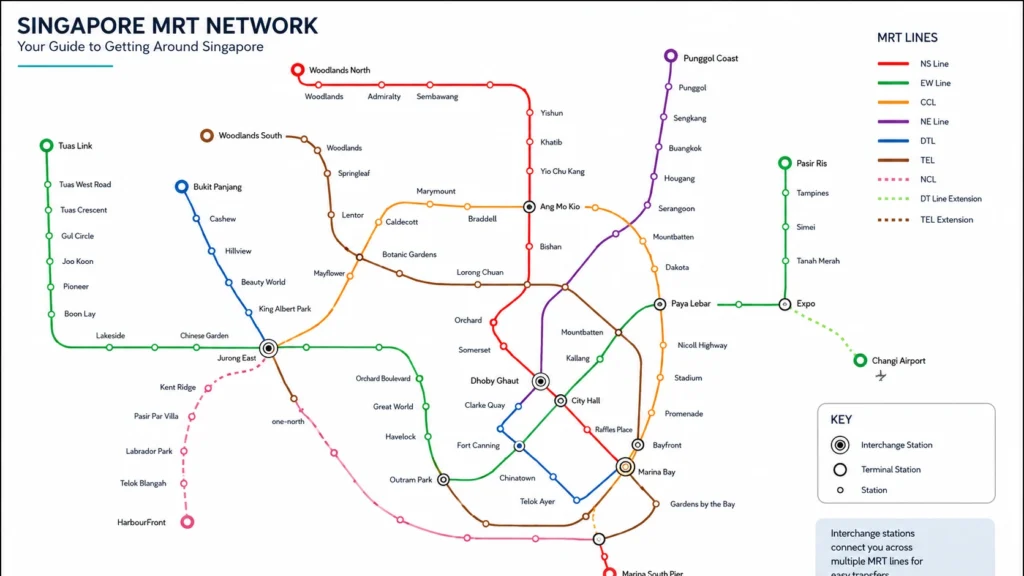
These major MRT interchanges form important MRT connection points across Singapore and can be useful when comparing different MRT routes Singapore.
Singapore MRT Map: Lines, Codes and Interchanges Explained
The Singapore MRT map uses different colours to show each MRT line. Station codes help passengers identify their location, while interchange symbols show where they can change lines.
When reading the MRT map Singapore, check the line colour, travel direction, station code, and transfer points. Terminal stations mark the end of a line, while exit signs help you choose the correct way out of larger stations.
For a journey, find your starting station, follow the line to your destination, and note any required interchange.
How to Plan an MRT Route in Singapore
Planning an MRT route Singapore is simple once you know your starting point, destination, and any required transfers. Follow these steps before starting your journey.
Step 1: Find Your Starting Station
Check the nearest MRT station to your location.
Step 2: Find Your Destination
Search for the MRT station closest to your destination.
Step 3: Check the MRT Line
See which Singapore MRT line serves your starting station and destination.
Step 4: Check the Interchange
If both stations are on different lines, find the best MRT interchange for the transfer.
Step 5: Check the Direction
Look at the train’s direction and confirm the final station or route shown on the platform signs.
Step 6: Check Journey and Payment Details
Before travelling, check the expected journey, fare, and available payment method.
Example: Changi Airport to Orchard Road
From Changi Airport, take the MRT towards the city and transfer at the appropriate interchange for the Orchard MRT area. Check the current route before travelling, as the quickest connection can change with service updates.
Singapore MRT Fares, Tickets and Payment Options
Singapore MRT fares depend on the journey and the payment method used. Before travelling, you can check the expected fare with the official fare calculator rather than relying on a fixed ticket price.
For most adult journeys, contactless bank cards can be used through SimplyGo. Supported cards can be tapped at the MRT fare gates without registering for a SimplyGo account. Mobile wallets linked to supported cards can also be used.
Another option is a SimplyGo EZ-Link card, which can be topped up and managed through the SimplyGo app. EZ-Link cards are available at selected MRT stations, ticket offices, vending machines, and retail locations.
For tourists, using a contactless bank card can be convenient if the card is supported for Singapore public transport. Before your first MRT travel journey, check card compatibility, payment charges, and the latest fare information.
Singapore MRT Operating Hours and Peak Times
Singapore MRT trains generally operate from around 5:30am to midnight daily. Exact first and last train timings can vary by line and station, so check the latest schedule before a late-night or early-morning journey.
Peak travel is usually busiest during weekday mornings and evenings. LTA lists peak frequency around 7am to 9am, while trains generally run less frequently during off-peak periods.
Weekend travel can have temporary changes because of maintenance, engineering works, or special events. For current MRT timings Singapore, service changes, and first or last train information, check LTA’s MyTransport.SG app or the official MRT/LRT service updates before travelling.
Changi Airport to Singapore by MRT
For many travellers, the MRT from Changi Airport to city is a convenient way to reach central Singapore. Changi Airport MRT Station is linked to Terminals 2 and 3, with airport facilities providing access from the other terminals.
Changi Airport MRT Station
The airport station connects with the East-West Line. Passengers travelling towards the city can transfer at Tanah Merah and continue towards their destination.
Changi Airport to Singapore City
For Changi Airport to Singapore by MRT, take the train towards Tanah Merah and change to the city-bound service. From there, you can continue to stations across central Singapore.
Changi Airport to Orchard Road
Travellers heading to Orchard Road can use the MRT and transfer to a suitable connection for Orchard MRT. Check the current route before travelling, as the quickest option can depend on service conditions.
Changi Airport to Marina Bay
To reach Marina Bay, travel towards the city and use the appropriate MRT connection for Marina Bay MRT. The station provides access to the Marina Bay area and nearby attractions.
Changi Airport to Singapore CBD
The MRT also provides connections towards Singapore’s CBD, including areas around Raffles Place and City Hall. These stations are useful for business districts and central attractions.
Returning to Changi Airport
For the return journey, check the Singapore MRT to Changi Airport route before leaving the city. Allow extra time for transfers, luggage, and airport check-in.
Before You Travel
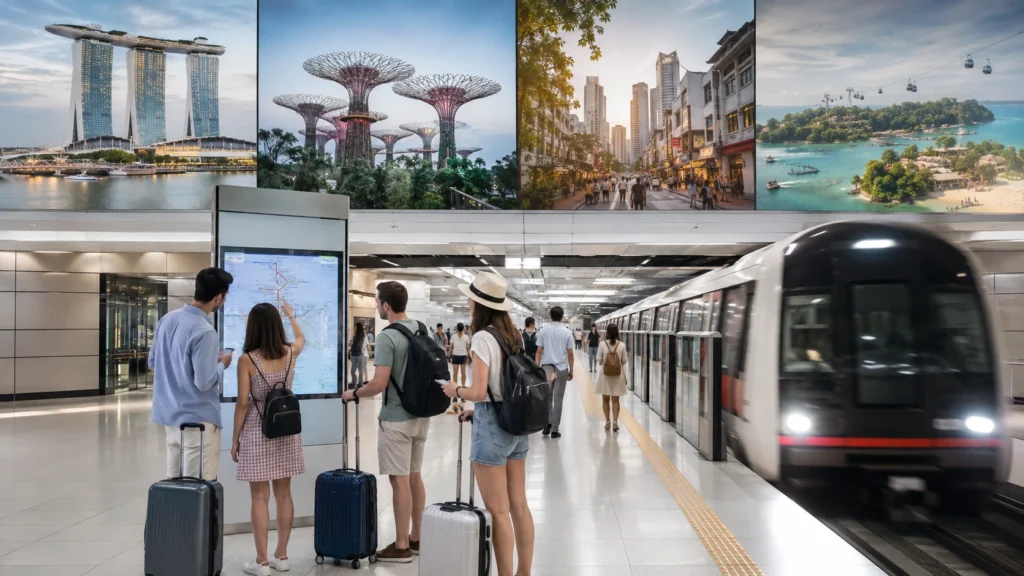
Check the latest train timings, service updates, route and fare before starting your MRT travel. This is especially useful for early flights, late arrivals, or journeys requiring multiple transfers.
Singapore MRT for Tourists
The Singapore MRT for tourists is a convenient way to reach many popular areas without depending on taxis for every trip. Most major attractions are close to an MRT station, and clear signs inside stations make it easier to find platforms, transfers, and exits.
For a Singapore MRT guide for tourists, start by checking the MRT map and finding the station closest to your destination. If your journey requires a transfer, look for the interchange symbol and follow the signs for the connecting line.
Choosing the right station can also save walking time. Before leaving the train, check the station exit information because larger stations may have several exits leading to different streets and attractions.
MRT Stations Near Popular Attractions
| MRT Station | Popular Area / Attraction |
| Orchard | Orchard Road |
| Bayfront | Marina Bay / Gardens by the Bay |
| HarbourFront | Sentosa |
| Chinatown | Chinatown |
| Little India | Little India |
| Bugis | Kampong Glam |
| City Hall | Civic District |
Best MRT Stations for Singapore Attractions
Using the MRT makes it easy to reach many popular places across Singapore. The best station depends on the attraction and the nearest exit.
- MRT to Marina Bay Sands: Bayfront MRT is the main station for Marina Bay Sands.
- MRT to Gardens by the Bay: Bayfront provides access to Gardens by the Bay.
- MRT to Sentosa: HarbourFront MRT connects with Sentosa through VivoCity and the Sentosa Express.
- MRT to Orchard Road: Orchard MRT is convenient for the main shopping district.
- MRT to Chinatown: Chinatown MRT serves the historic Chinatown area.
- MRT to Little India: Little India MRT is close to the neighbourhood’s main attractions.
- MRT to Bugis: Bugis MRT provides access to Bugis Street and Kampong Glam.
- MRT to Universal Studios Singapore: HarbourFront MRT is the main MRT station for reaching Resorts World Sentosa and Universal Studios Singapore.
Checking the station exit before leaving can save walking time, especially at larger MRT stations.
Future MRT Network and Planned Stations
Singapore’s rail network is continuing to expand, with several MRT projects adding new stations and connections. In 2026, the Circle Line Stage 6 has completed the loop with three new stations: Keppel, Cantonment and Prince Edward Road. The Downtown Line 3 Extension and Thomson-East Coast Line Stage 5 are also scheduled to open later in 2026.
New MRT Lines and Extensions
The Cross Island Line (CRL) is planned to become Singapore’s eighth MRT line, connecting eastern, western and north-eastern areas. Phase 1 is targeted for 2030, while Phase 2 and the Punggol Extension are planned for 2032.
The Jurong Region Line (JRL) will add rail connections around Jurong and Tengah, with its first stage now targeted for mid-2028. LTA is also studying future rail projects, including the Seletar Line, Tengah Line and West Coast Extension of the JRL.
These future MRT stations Singapore projects will expand the future Singapore MRT network, improve connections to new residential areas, and give commuters more route choices across the island.
Frequently Asked Questions
What is the MRT network in Singapore?
Singapore’s MRT network is the main urban rail system, connecting residential areas, business districts, shopping areas, and attractions.
How long is the Singapore MRT network?
Singapore’s MRT network spans about 240 km across six MRT lines.
How many MRT stations are there in Singapore?
Singapore has more than 170 MRT stations across its rail network.
What are the peak hours on the Singapore MRT?
Weekday mornings and evenings are usually the busiest periods, especially during commuting hours.
Is the Singapore MRT fully electric?
Yes. Singapore’s MRT trains run on electricity supplied through the rail system rather than petrol or diesel fuel.
Singapore MRT Network Guide: Quick Summary
The MRT Network Guide Singapore covers the main MRT lines, stations, interchange points, routes, fares, and operating hours. The network also provides a direct rail connection from Changi Airport to other parts of Singapore through the East-West Line. For tourists, MRT stations near Orchard Road, Marina Bay, Chinatown, Sentosa, and other attractions make sightseeing easier. Checking the MRT map, route, payment method, and latest service updates before travelling can make each journey simpler.