
 By Global Arena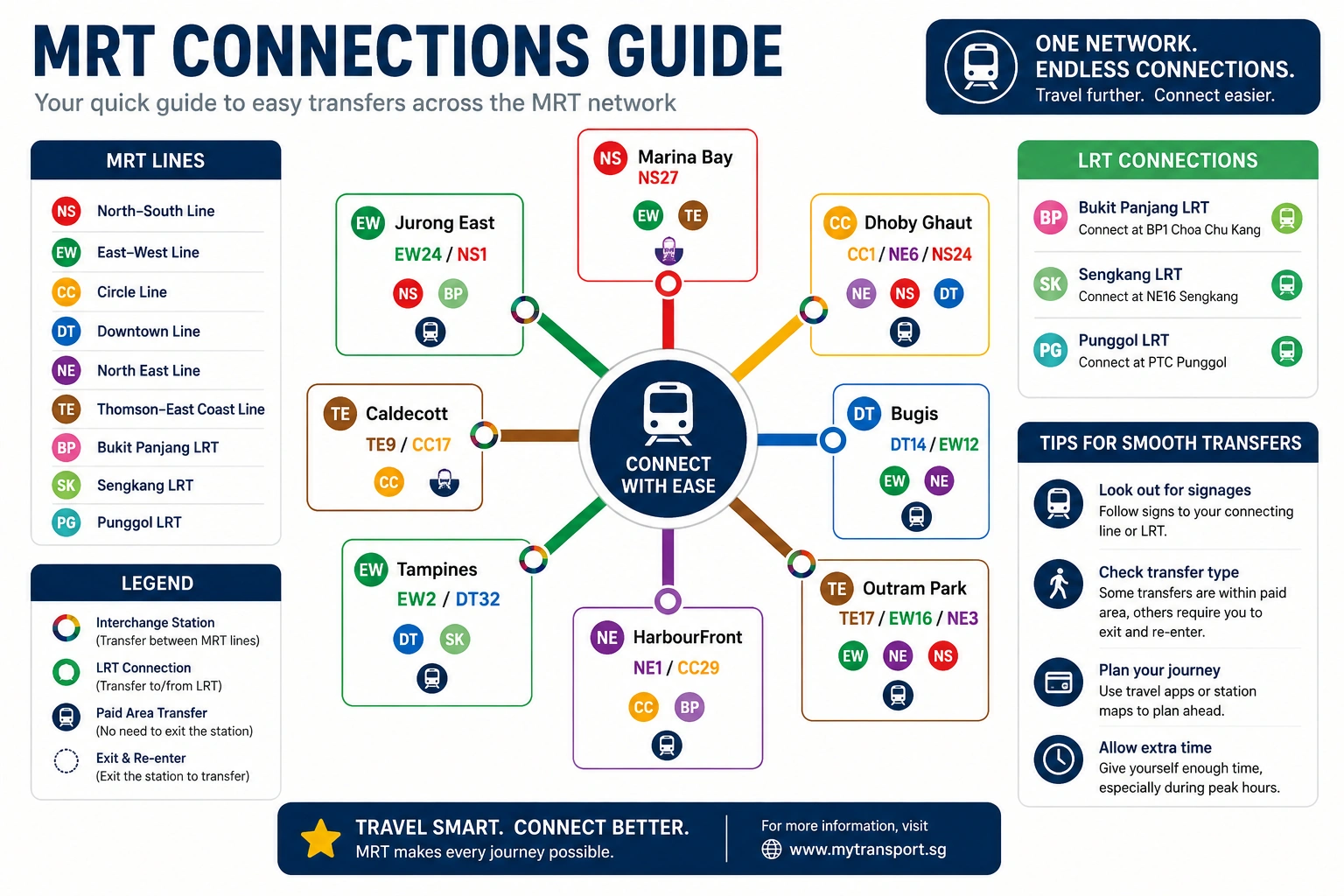
Singapore MRT connections make it easier to travel between different parts of the city without relying on a car. The Singapore MRT network covers major residential areas, business districts, shopping zones and tourist destinations through several connected MRT lines. For many journeys, the main question is not just which train to take, but which MRT interchange should you use and whether another route would be simpler.
This MRT Connections Guide explains how Singapore MRT routes work, where the main interchange stations are, and how to transfer between lines. It also covers popular routes, airport connections, station exits and practical route-planning tips. From Changi Airport and Orchard Road to Marina Bay, Bugis, Chinatown and HarbourFront, the guide focuses on real travel situations rather than a basic MRT map or station list.
The aim is simple: help you understand the Singapore MRT network, choose suitable connections and plan an easier MRT journey from one destination to another.
What Is an MRT Interchange in Singapore?
An MRT interchange is a station where two or more MRT lines meet, allowing passengers to change from one line to another. These stations are a key part of the Singapore MRT network because they connect different areas without requiring a separate transport service.
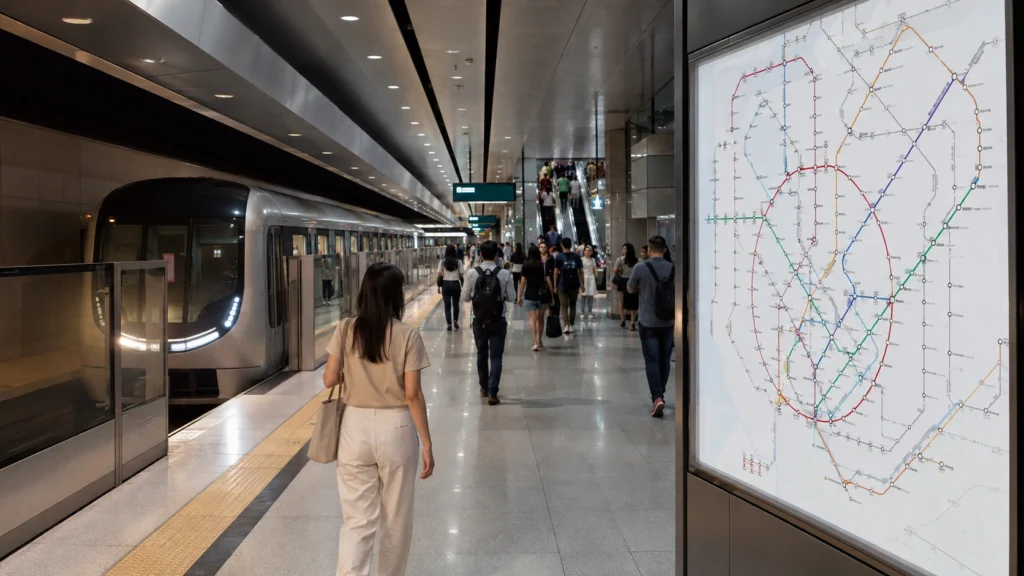
An interchange is useful when your destination is not on the same line as your starting station. After leaving your train, follow the signs showing the connecting MRT line and check the direction of travel before entering the next platform.
Station signs usually show the MRT line name, colour, station names and train direction. Checking these details before boarding helps prevent taking a train in the wrong direction.
MRT Transfer vs Direct MRT Journey
A direct MRT journey means you stay on the same train until your destination. An MRT transfer means you leave your current train at an interchange and board another train on a different line.
| Journey Type | How It Works | Best For |
| Direct journey | Stay on the same MRT line | Simple routes with no line change |
| MRT transfer | Change trains at an interchange | Destinations on another MRT line |
| Multiple transfers | Change lines more than once | Longer cross-city journeys |
A direct route is usually simpler, but a transfer can give you more MRT route options when travelling across Singapore.
How MRT Line Changes Work
Changing MRT lines is straightforward once you know what to look for:
- Check your destination — Identify the MRT line serving your destination station.
- Find an interchange — Look for a station where your current line connects with the required line.
- Leave the train — Get off at the interchange station and follow the signs for the connecting line.
- Check the direction — Before entering the platform, confirm the train direction and upcoming stations.
- Find the correct platform — Use the station signs and electronic displays to confirm the platform.
- Board the connecting train — Check the station name on the display before boarding.
- Check your exit — At the destination, follow the signs for the correct station exit if you are heading to a specific building, attraction or street.
For longer journeys, checking the MRT map, route options and service information before leaving can make the trip easier. The same approach works whether you are a regular commuter or using Singapore MRT connections for tourists.
Singapore MRT Lines and Their Main Connections
Singapore MRT lines connect the main parts of the city through key interchange stations. Knowing these connections makes it easier to choose an MRT route and change lines when needed.
North-South Line Connections
The North-South Line (NSL) connects northern Singapore with major central areas such as Orchard, City Hall and Marina Bay.
Key connections: Dhoby Ghaut, City Hall and Marina Bay.
It is useful for north-to-city MRT routes, including journeys from Woodlands, Yishun and Bishan.
East-West Line Connections
The East-West Line (EWL) runs between western and eastern Singapore and provides the main rail connection toward Changi Airport.
Key connections: City Hall, Bugis, Paya Lebar and Tanah Merah.
It is useful for Changi Airport MRT connections, CBD travel and west-to-east journeys.
North-East Line Connections
The North-East Line (NEL) connects Punggol and other north-eastern areas with central Singapore and HarbourFront.
Key connections: Serangoon, Little India, Chinatown and HarbourFront.
It provides useful MRT line connections for travellers heading between the north-east, city centre and southern Singapore.
Circle Line Connections
The Circle Line (CCL) links several MRT lines around central and southern Singapore.
Key connections: HarbourFront, Dhoby Ghaut, Paya Lebar, MacPherson, Promenade and Marina Bay.
Circle Line Stage 6 — 2026 Update
Circle Line Stage 6 opened in July 2026, adding Keppel, Cantonment and Prince Edward Road. The extension completed the Circle Line connection between HarbourFront and Marina Bay and created new travel options in southern Singapore.
Downtown Line Connections
The Downtown Line (DTL) serves central and eastern Singapore, including major areas such as Bugis, Little India, Chinatown and Tampines.
Key connections: Bugis, Little India, Chinatown, MacPherson and Promenade.
These connections make the DTL useful for city-centre and east-side MRT routes.
Thomson-East Coast Line Connections
The Thomson-East Coast Line (TEL) connects northern, central and eastern areas of Singapore.
Key connections: Woodlands, Stevens, Orchard, Marina Bay and Outram Park.
The TEL provides additional MRT route options for journeys between Woodlands, Orchard, Marina Bay and eastern Singapore.
Singapore MRT Connections at a Glance
Singapore MRT interchange stations connect two or more MRT lines, making transfers between different parts of the city easier. The table below highlights major MRT connections, their connected lines and the areas they are most useful for.
| MRT Interchange | Connected Lines | Best For |
| Dhoby Ghaut | NSL, NEL, CCL | Central Singapore |
| Outram Park | EWL, NEL, TEL | Chinatown and southern routes |
| Marina Bay | NSL, CCL, TEL | Marina Bay and CBD |
| Paya Lebar | EWL, CCL | East and central Singapore |
| Bugis | EWL, DTL | Bugis and city centre |
| Serangoon | NEL, CCL | North-East Singapore |
| MacPherson | CCL, DTL | East-central routes |
| HarbourFront | NEL, CCL | Sentosa and southern Singapore |
Major MRT Interchange Stations You Should Know
Some MRT interchanges are more useful than others because they connect major lines and popular areas. These stations can make Singapore MRT route planning easier when your destination requires a line change.
Dhoby Ghaut MRT
Dhoby Ghaut connects North-South, North-East and Circle lines. It is a key interchange for central Singapore, Orchard and Little India.
Outram Park MRT
Outram Park links East-West, North-East and Thomson-East Coast lines. It is useful for Chinatown, SGH and cross-island travel.
Marina Bay MRT
Marina Bay connects North-South, Circle and Thomson-East Coast lines. It serves Marina Bay, CBD and nearby business areas.
HarbourFront MRT
HarbourFront links North-East and Circle lines. It is the main stop for VivoCity and Sentosa access.
Paya Lebar MRT
Paya Lebar connects East-West and Circle lines. It is a key transfer point for eastern Singapore routes.
Bugis MRT
Bugis links East-West and Downtown lines. It connects Bugis, Kampong Glam and central MRT routes.
How to Choose the Best MRT Connection
The best MRT connection in Singapore is not always the route with the fewest stops. A slightly longer journey can be easier if it has fewer transfers, shorter platform walks or a simpler interchange. Looking at these details makes MRT route planning more practical.
Check the Number of Transfers
Fewer transfers usually mean less walking and less time spent changing trains. For a simple journey, compare routes with one transfer against options that require two or more changes.
For easiest MRT routes in Singapore, a route with slightly more stops may be better if you can stay on the same train for longer.
Compare Alternative MRT Routes
Popular destinations often have more than one way to reach them. Check the available MRT route options before choosing a connection.
For example, compare the interchange, number of line changes and overall journey before deciding. The fastest MRT connections can change depending on your starting station and destination.
Consider Walking Between Platforms
Not every MRT transfer feels the same. Some interchanges involve more walking between platforms than others.
If you are travelling with luggage, children or during busy periods, a route with a simpler transfer can be more comfortable even if it takes a little longer. Check station signs and directions carefully when changing lines.
Best MRT Connections for Popular Singapore Routes
Changi Airport to Central Singapore: Take the airport MRT branch towards Tanah Merah, then continue on the East-West Line towards City Hall, Raffles Place or Bugis. For Orchard Road or Marina Bay, check the most suitable connection based on your final station.
Orchard to Marina Bay: Use the North-South or Thomson-East Coast lines depending on your starting point. HarbourFront to Marina Bay is now easier through the Circle Line after the 2026 Stage 6 opening, while Bugis offers East-West and Downtown Line connections towards Marina Bay.
Jurong East to Raffles Place: The East-West Line provides a direct connection towards the CBD. Before travelling, check the MRT map, train direction and available MRT route options to choose a simple connection.
MRT Connections from Changi Airport
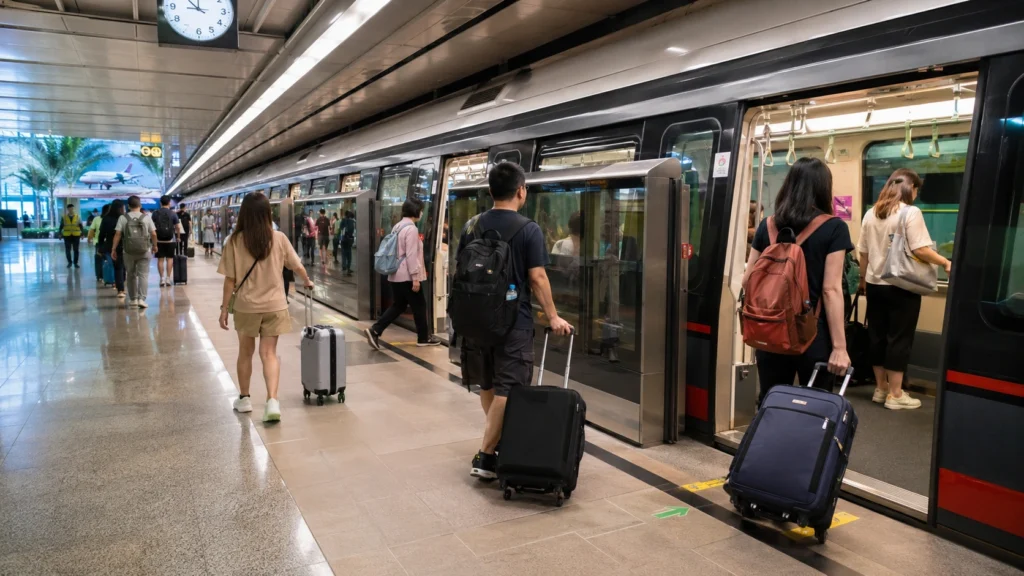
Changi Airport is connected to Singapore’s MRT network through the airport branch of the East-West Line. These Changi Airport MRT connections provide access to central Singapore and major destinations.
Changi Airport to City Centre
- Take the airport MRT branch towards Tanah Merah.
- Continue on the East-West Line towards City Hall or Raffles Place.
- Useful for central Singapore and CBD travel.
Changi Airport to Orchard
- Travel from Changi Airport towards Tanah Merah.
- Continue towards central Singapore.
- Change to a suitable MRT connection for Orchard Road.
Changi Airport to Marina Bay
- Take the MRT from Changi Airport towards central Singapore.
- Choose a suitable connection for Marina Bay.
- Check the current MRT map for the simplest route.
Changi Airport to HarbourFront
- Travel towards central Singapore from Changi Airport.
- Connect to the Circle Line or North-East Line.
- Get off at HarbourFront for VivoCity and Sentosa.
Changi Airport to Singapore CBD
- Travel towards City Hall or Raffles Place on the East-West Line.
- Both stations provide access to major CBD areas.
- Check the final destination before selecting the MRT route.
MRT Connections to Popular Singapore Destinations
Singapore MRT connections make it easier to reach major attractions, shopping areas and business districts. Marina Bay can be reached through Marina Bay MRT, which connects the North-South, Circle and Thomson-East Coast lines. Orchard Road is served by Orchard MRT on the North-South and Thomson-East Coast lines, while Bugis connects the East-West and Downtown lines. For Chinatown, use Chinatown MRT on the North-East or Downtown Line, while Little India MRT connects the North-East and Downtown lines.
HarbourFront is the main MRT connection for VivoCity and Sentosa, with the North-East and Circle lines serving the station. Gardens by the Bay is accessible from Bayfront MRT, which connects the Circle and Downtown lines. For the Singapore CBD, Raffles Place, City Hall and Marina Bay provide key MRT connections. Singapore Expo is served by Expo MRT on the Downtown and East-West lines, with convenient access from the airport network.
How to Change MRT Lines in Singapore
Changing MRT lines in Singapore is simple when you know your interchange and train direction. Follow these steps:
- Check your current MRT line and destination.
- Find an interchange station connecting both lines.
- Follow station signs for the connecting MRT line.
- Check the train direction before entering the platform.
- Confirm your destination station on the display.
- Board the correct train and check the next stops.
How Do MRT Transfers Work?
An MRT transfer means changing from one train line to another at an interchange station. After leaving your train, follow the signs for the required line and check the platform direction before boarding.
How to Find the Correct MRT Platform
Check the MRT platform signs for the line name, destination direction and upcoming stations. Electronic displays also show the next arriving train, so confirm your route before boarding.
How to Check MRT Station Exits
MRT stations often have several exits leading to different streets, buildings and attractions. Check the MRT station exits signs before leaving the station, especially when travelling to a specific hotel, mall or tourist attraction.
How to Plan an MRT Journey in Singapore
Good MRT route planning starts with your current station and final destination. Check the required MRT line, possible interchange, number of transfers, estimated MRT travel time and fare before starting the journey. It is also useful to check station exits, service information and the first and last train if you are travelling early or late.
Using the MRT Map
The Singapore MRT map shows MRT lines, interchange stations and station names. Find your starting station and destination first, then identify the connecting line and interchange needed for the journey.
Checking MRT Route Options
Compare different MRT route options instead of choosing the first result. Look at the number of transfers, travel time and walking distance between platforms. A route with fewer changes may be easier, while another route may save travel time.
Checking Service Updates
Check current MRT service information before leaving, especially during peak hours or late-night travel. Also confirm the first and last train times when your journey depends on a specific departure.
Singapore MRT Connections in 2026
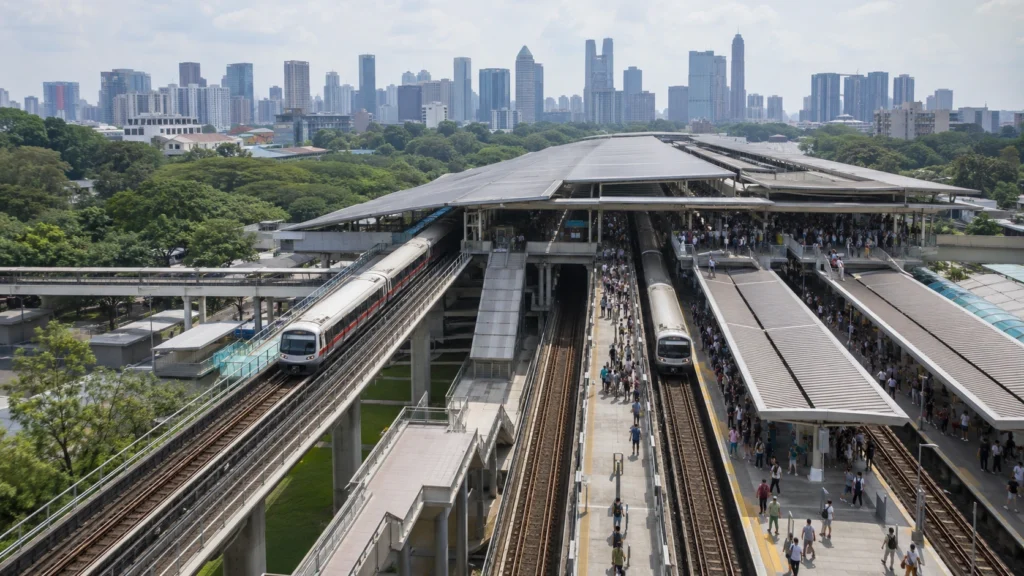
Singapore MRT connections saw an important change in 2026 with the opening of Circle Line Stage 6. The extension added Keppel, Cantonment and Prince Edward Road stations and completed the Circle Line connection between HarbourFront and Marina Bay. This gives commuters more route choices across southern Singapore and the CBD.
Circle Line Stage 6
Circle Line Stage 6 opened for passenger service on 12 July 2026, bringing the Circle Line to 33 stations. The extension improves connections between HarbourFront, Keppel, Cantonment, Prince Edward Road and Marina Bay.
New Keppel MRT Connection
Keppel MRT adds a new rail connection for the Keppel area and nearby developments. It also gives passengers another option for travelling between HarbourFront and central Singapore.
Cantonment MRT Connection
Cantonment MRT provides access to the Cantonment and Tanjong Pagar areas. Its location makes it useful for nearby residential, commercial and heritage destinations.
Prince Edward Road MRT Connection
Prince Edward Road MRT adds another station along the southern Circle Line route. It improves access to the Shenton Way area and provides a direct connection towards Marina Bay.
How the 2026 Changes Affect MRT Routes
The completed Circle Line creates new MRT route options between southern Singapore, HarbourFront and Marina Bay. Some journeys now require fewer transfers, while travellers can also avoid travelling through busy central interchanges for certain routes.
Singapore MRT Connections vs Other Public Transport
Singapore has several public transport options, but each works differently. The MRT transport network is useful for longer journeys and cross-city travel, while buses are better for local areas. Taxis and ride-hailing services offer direct travel, and walking works well for short distances.
| Transport | Best For | Connection Style |
| MRT | Long city journeys | Line transfers |
| Bus | Local areas | Bus-to-MRT or bus-to-bus |
| Taxi/Ride-hailing | Door-to-door trips | No transfer |
| Walking | Short distances | Direct |
For most cross-city trips, Singapore MRT connections provide a simple way to move between major areas. For shorter routes or destinations far from an MRT station, combining MRT with buses or walking can be more practical.
MRT Connection Tips for Faster and Easier Journeys
A few simple checks can make MRT route planning easier, especially when travelling across multiple lines or using a busy interchange.
- Avoid unnecessary transfers: If two routes are similar, choose the one with fewer line changes.
- Check alternative interchanges: A different interchange may offer a shorter or simpler transfer.
- Choose the right station exit: Check the nearest exit for your hotel, mall, office or attraction.
- Consider peak hours: Busy periods can mean more crowded trains and longer platform walks.
- Check service information: Look for delays, maintenance or temporary changes before travelling.
- Follow interchange signs: Large stations can have several platforms, so check the line and train direction carefully.
- Look beyond the number of stops: A route with more stops can still be easier if it requires fewer transfers.
Frequently Asked Questions About MRT Connections
What does MRT stand for?
MRT stands for Mass Rapid Transit. It is Singapore’s main urban rail system, connecting residential areas, business districts and major attractions.
How many MRT lines are there in Singapore?
Singapore has several major MRT lines, including the North-South, East-West, North-East, Circle, Downtown and Thomson-East Coast lines. These lines connect through numerous interchange stations.
Which MRT station has the most connections?
Dhoby Ghaut is one of Singapore’s key interchanges, connecting the North-South, North-East and Circle lines. It is an important transfer point in central Singapore.
How do I change MRT lines in Singapore?
Get off at an interchange station and follow the signs for your connecting MRT line. Check the train direction and platform before boarding.
Which MRT line goes to Changi Airport?
Changi Airport is connected to the East-West Line through the airport branch. Tanah Merah is the main connection between the airport branch and the wider MRT network.
Final Thoughts
Singapore MRT connections become much easier when you know the right interchange, train direction and station exit. This MRT Connections Guide helps you choose practical routes, avoid unnecessary transfers and plan a smoother journey across Singapore.