
 By Global Arena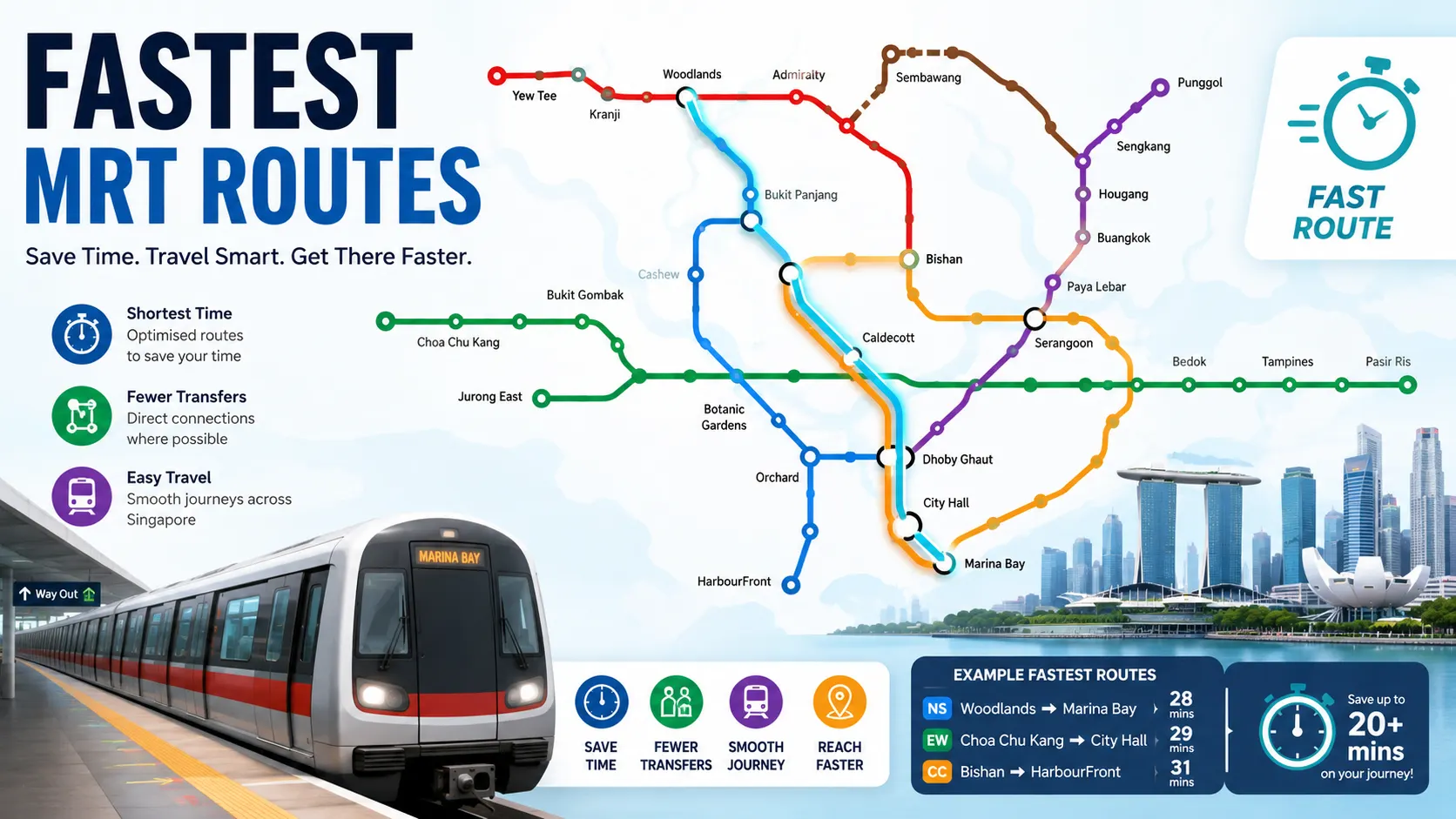
Getting around Singapore is usually fast, but choosing the right MRT route can save even more time. A direct train or a route with fewer transfers often gets you to your destination quicker than simply following the shortest distance. For daily commuters, tourists, and families exploring the city, understanding the Fastest MRT Routes makes every trip smoother and less stressful.
Here’s what you’ll learn:
- Find the fastest MRT routes in Singapore for popular destinations.
- Compare the North-South Line, East-West Line, Circle Line, Downtown Line, and Thomson-East Coast Line.
- Learn which MRT interchange stations help reduce transfer time.
- Discover practical Singapore MRT travel tips for daily commuters and visitors.
- See route comparison tables with estimated MRT travel time.
- Avoid common mistakes that can make your MRT journey longer.
- Choose the best MRT routes for Orchard Road, Marina Bay, Changi Airport, HarbourFront, and Bugis.
- Understand how peak hours, train frequency, and direct train connections affect your journey.
This format is more engaging for readers, improves readability, and gives Google a clear overview of the page content right at the beginning.
TL;DR
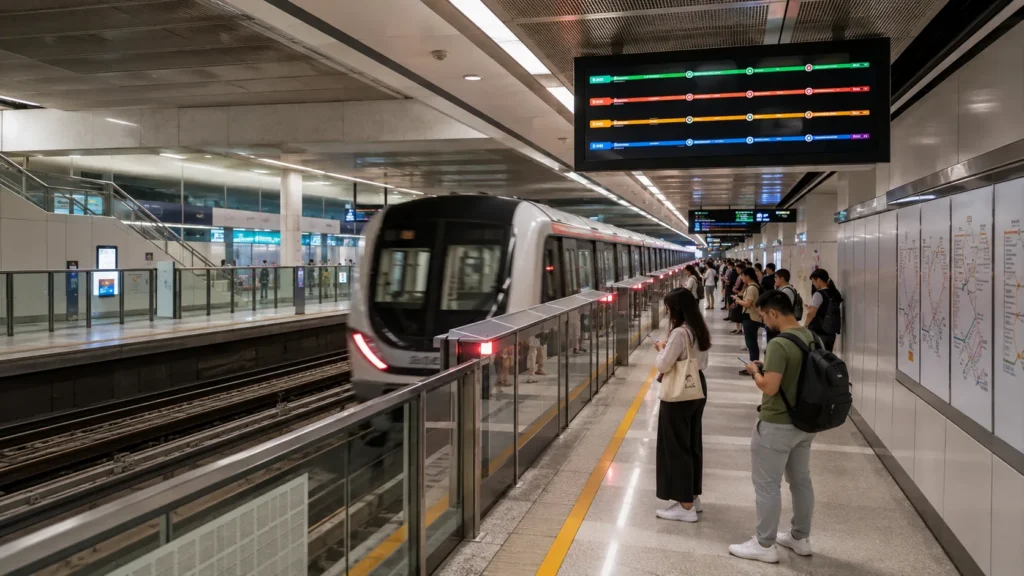
- Fastest MRT Routes usually have fewer transfers and shorter waiting times.
- The North-South Line, East-West Line, and Circle Line are among the quickest options for many popular destinations.
- Travelling to Orchard Road, Marina Bay, Bugis, HarbourFront, and Changi Airport is often faster when you choose the right interchange station.
- Avoiding peak hours and checking train frequency can reduce your total MRT travel time.
- Planning your Singapore MRT journey before leaving helps you reach your destination more efficiently.
| Destination | Recommended MRT Line | Typical Transfers | Estimated Travel Time* |
| Orchard Road | North-South Line | 0–1 | 15–30 mins |
| Marina Bay | North-South Line / Circle Line | 0–1 | 20–35 mins |
| Changi Airport | East-West Line | 1 | 35–45 mins |
| HarbourFront (Sentosa Gateway) | Circle Line | 0–1 | 20–35 mins |
| Bugis | Downtown Line / East-West Line | 0–1 | 15–30 mins |
| City Hall | North-South Line / East-West Line | 0–1 | 15–30 mins |
| Dhoby Ghaut | North-South Line / Circle Line | 0–1 | 15–25 mins |
| Jurong East | East-West Line / North-South Line | 0–1 | 25–40 mins |
What Are the Fastest MRT Routes in Singapore?
The Fastest MRT Routes are the journeys that help you reach your destination in the shortest time. In the Singapore MRT network, the quickest route usually depends on direct train services, fewer transfers, train frequency, and efficient MRT interchange stations rather than the shortest distance.
Also Read: Tuas Crescent MRT Guide: Station Details, Nearby Places, Food, Transport
What Is the Fastest MRT Route?
A fast MRT route is the one that takes the least time to complete. It often includes a direct train or just one transfer, making your MRT journey quicker and more convenient.
Fastest Route vs. Shortest Route
| Fastest Route | Shortest Route |
| Focuses on saving travel time | Focuses on the shortest distance |
| Usually has fewer transfers | May include multiple transfers |
| Better for daily commuters | May not always be the quickest |
Why Fewer Transfers Matter
Every transfer adds extra walking and waiting time. Choosing Fastest MRT Routes with fewer transfers can help you reach places like Orchard Road, Marina Bay, or Changi Airport more quickly while making your journey smoother.
Why Some MRT Routes Are Faster Than Others
Not every Singapore MRT route takes the same amount of time. Some journeys are quicker because they use direct trains, efficient MRT interchange stations, and shorter transfer times. A few small factors can make a big difference to your overall MRT travel time.
Direct Trains
A direct train helps you reach your destination without changing lines. Less waiting means a faster and smoother MRT journey.
MRT Interchange Stations
Stations like Dhoby Ghaut, City Hall, and Jurong East make it easier to switch between MRT lines. Well-planned transfers can save several minutes.
Train Frequency
Some MRT lines have trains arriving more often than others. Shorter waiting times usually lead to quicker journeys.
Peak Hours
Morning and evening rush hours can slow your trip because platforms and trains are busier. Travelling during off-peak hours is often faster.
Walking Distance Between Platforms
Large interchange stations may require a longer walk between platforms. Choosing a route with easier transfers can reduce your total travel time.
Factors Affecting MRT Travel Time
| Factor | Impact on Your Journey |
| Direct train | Reduces travel and waiting time |
| MRT interchange | Makes transfers quicker |
| Train frequency | Less waiting between trains |
| Peak hours | Can increase journey time |
| Walking distance | Longer walks may slow transfers |
Fastest MRT Routes to Popular Places in Singapore
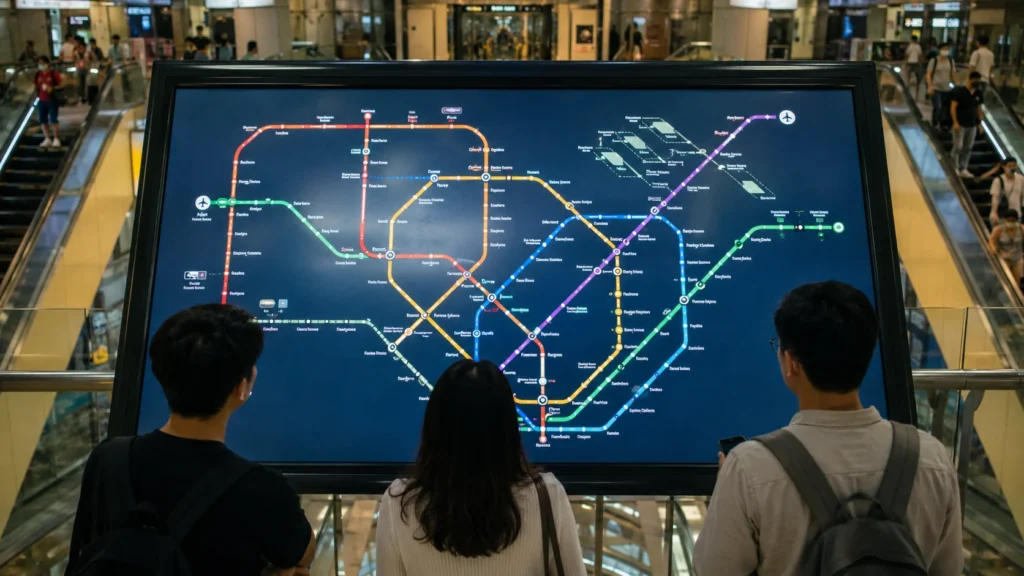
The Singapore MRT makes it easy to reach major attractions, shopping areas, and business districts. Picking the right route can reduce MRT travel time and avoid unnecessary transfers.
Fastest MRT Route to Orchard Road
- Best Line: North-South Line
- Best Transfer: Dhoby Ghaut (if needed)
- Direct trains are usually the fastest option.
Fastest MRT Route to Marina Bay
- Best Line: North-South Line or Circle Line
- Best Transfer: City Hall
- Ideal for the CBD and waterfront area.
Fastest MRT Route to Changi Airport
- Best Line: East-West Line
- Best Transfer: Tanah Merah
- The quickest rail connection to the airport.
Fastest MRT Route to HarbourFront
- Best Line: Circle Line
- Best Transfer: Outram Park
- Best choice for Sentosa visitors.
Fastest MRT Route to Bugis
- Best Line: Downtown Line or East-West Line
- Best Transfer: Little India (when required)
- A fast route for shopping and dining.
Best MRT Routes Comparison
| Destination | Best MRT Line | Key Transfer |
| Orchard Road | North-South Line | Dhoby Ghaut |
| Marina Bay | North-South / Circle Line | City Hall |
| Changi Airport | East-West Line | Tanah Merah |
| HarbourFront | Circle Line | Outram Park |
| Bugis | Downtown / East-West Line | Little India |
Best MRT Interchange Stations for Faster Transfers
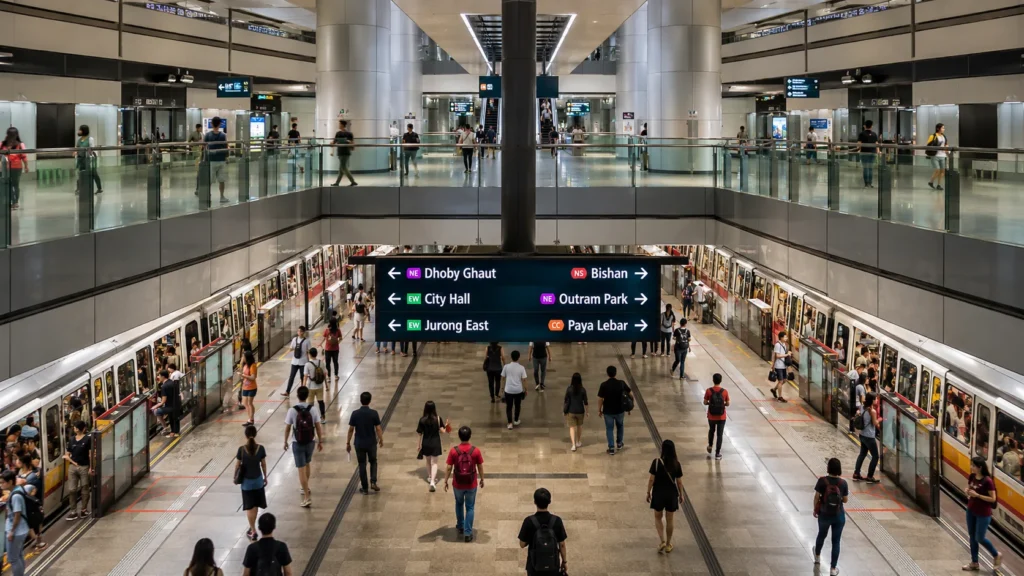
Some MRT interchange stations help reduce travel time by offering quick connections between different MRT lines Singapore. Choosing the right interchange can make your Singapore MRT journey smoother, especially during busy hours.
Also Read: North South Line Guide: Everything You Need to Know Before Your Journey
Dhoby Ghaut
Dhoby Ghaut connects three MRT lines, making it one of the best stations for reaching Orchard Road and other central areas with fewer transfers.
City Hall
City Hall provides quick access to the North-South Line and East-West Line, making it a popular transfer point for Marina Bay and the CBD.
Jurong East
Jurong East is a major interchange for commuters travelling between western Singapore and the city, with fast connections between two busy MRT lines.
Bishan
Bishan links the North-South Line and Circle Line, offering convenient transfers for commuters travelling across central Singapore.
Outram Park
Outram Park connects three MRT lines and is one of the quickest transfer stations for HarbourFront, Chinatown, and nearby attractions.
Paya Lebar
Paya Lebar makes it easy to switch between the East-West Line and Circle Line, helping commuters travel across eastern Singapore with less waiting.
Best MRT Interchange Stations
| MRT Station | Connected Lines | Best For |
| Dhoby Ghaut | NSL, NEL, CCL | Orchard Road |
| City Hall | NSL, EWL | Marina Bay & CBD |
| Jurong East | NSL, EWL | Western Singapore |
| Bishan | NSL, CCL | Central Singapore |
| Outram Park | EWL, NEL, TEL | HarbourFront & Chinatown |
| Paya Lebar | EWL, CCL | East Singapore |
Which MRT Line Is the Fastest?
The fastest MRT line depends on your destination. Some lines offer direct journeys, while others help reduce transfer time.
North-South Line
Best for travelling to Orchard Road, City Hall, and Marina Bay.
East-West Line
The quickest option for Changi Airport and many west-to-east journeys.
Circle Line
A good choice for faster transfers between major interchange stations.
Downtown Line
Provides convenient access to Bugis, Chinatown, and the city centre.
Thomson-East Coast Line
Connects northern and eastern Singapore with several MRT interchanges.
MRT Line Comparison
| MRT Line | Best For |
| North-South Line | Orchard Road & Marina Bay |
| East-West Line | Changi Airport |
| Circle Line | HarbourFront & Transfers |
| Downtown Line | Bugis & Chinatown |
| Thomson-East Coast Line | Woodlands & Orchard |
Common MRT Mistakes That Waste Time
Even a small mistake can increase your MRT travel time. Avoid these common issues to enjoy a faster Singapore MRT journey.
Wrong Train Direction
Always check the destination displayed on the platform before boarding.
Too Many Transfers
Choose routes with fewer transfers whenever possible to save time.
Ignoring Walking Distance
Some interchange stations require longer walks between platforms, adding extra minutes.
Travelling During Rush Hour
Peak hours are usually more crowded, leading to longer waiting and boarding times.
Not Checking Service Updates
Look for MRT service announcements before you travel to avoid delays.
Also Read: MRT Line Comparison: Which Singapore MRT Line Is Best
Frequently Asked Questions
What is the fastest MRT route in Singapore?
The fastest route depends on your starting point and destination. Routes with direct trains or fewer transfers are usually the quickest.
How can I find the fastest MRT route?
An MRT route planner or the latest MRT map can help you compare travel time, transfers, and the best route before you travel.
Does avoiding transfers make an MRT journey faster?
Yes. Fewer transfers mean less walking and waiting, which can shorten your overall journey.
Is the MRT faster than buses in Singapore?
For most longer journeys, the MRT is faster because it avoids road traffic. Buses are often more useful for short local trips.
What is the best time to travel on the Singapore MRT?
Off-peak hours are usually the best time to travel, with lighter crowds and shorter waiting times.
Conclusion
The Fastest MRT Routes aren’t always the shortest ones. A route with fewer transfers, reliable train frequency, and a convenient interchange can often get you there sooner. Whether you’re heading to Orchard Road, Marina Bay, Bugis, HarbourFront, or Changi Airport, spending a minute to plan your journey can save much more time later. As Singapore’s MRT network continues to grow, staying familiar with new connections and interchange stations makes every trip easier, whether it’s your daily commute or a weekend outing.