
 By Global Arena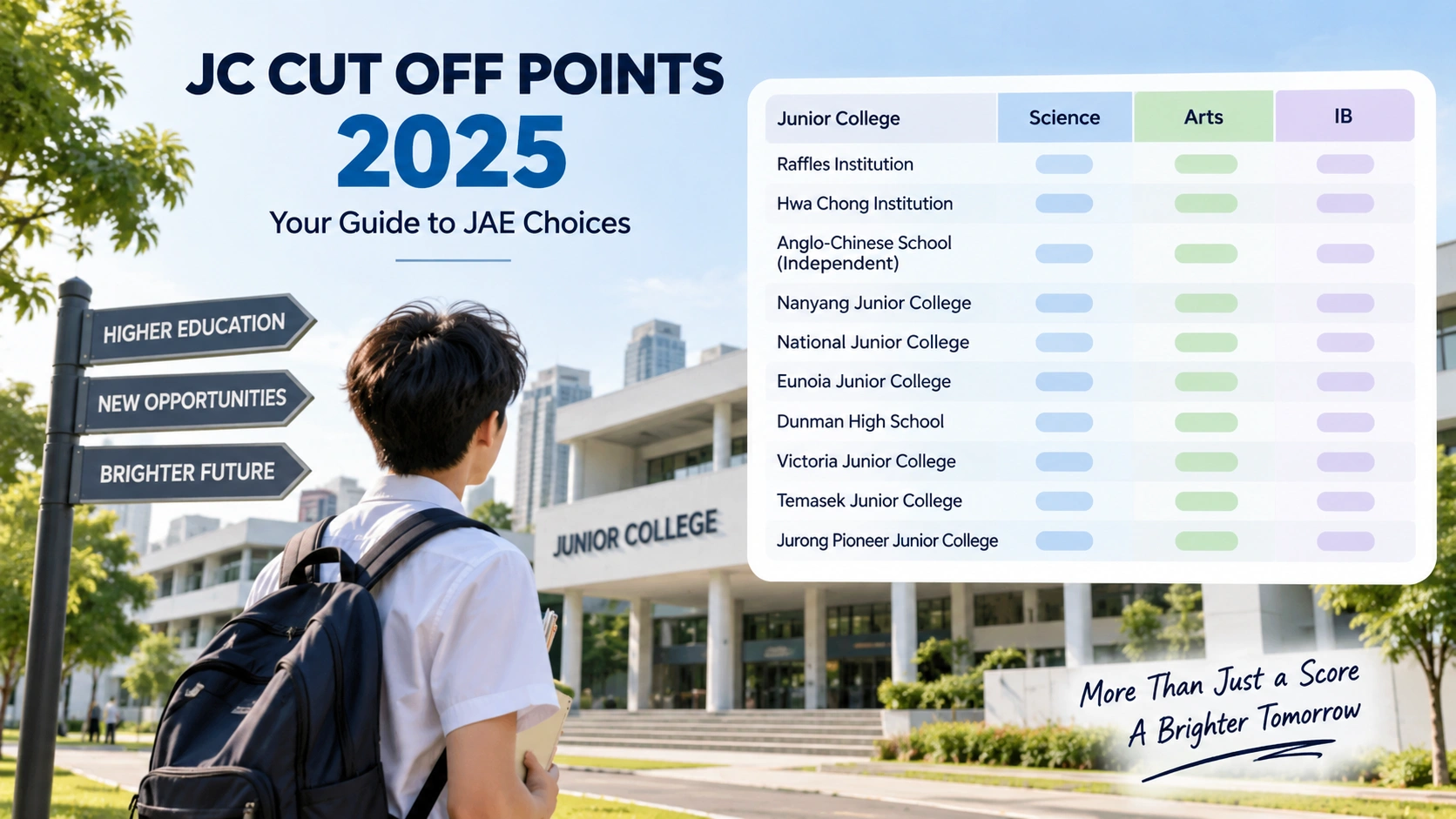
Choosing a Junior College is an important step for Singapore students after receiving their O-Level results. This guide brings together the JC cut off points 2025 to help you compare admission scores, understand how L1R5 works, and plan your JAE choices with greater confidence.
You will also learn why cut-off points can change and why school fit matters alongside academic results. Whether you are considering the Science, Arts, or IB pathway, the information can help you build a more balanced shortlist. This is a historical guide to the 2025 JAE intake, not a list of current or future admission cut-off points.
What Do JC Cut-Off Points Mean?
A Junior College cut-off point (COP) is the net L1R5 score of the last student admitted to a particular course through the Joint Admissions Exercise (JAE). It gives students a useful reference when comparing schools, but it is not a fixed admission requirement.

How a JC Cut-Off Point Is Determined
Each year, students submit their JAE choices after receiving their O-Level results. Admission depends on factors such as applicants’ scores, the number of available places, and demand for each course. The cut-off point is determined by the score of the last student admitted.
For example, if the last admitted student has a net L1R5 of 8, the COP is 8. This may change the following year, so the 2025 figures should be used as a guide rather than a guarantee.
Does Meeting the COP Guarantee Admission?
No. Meeting a previous year’s JC cut-off point does not guarantee admission. The COP is a historical reference, not a fixed entry requirement. Actual admission depends on the current year’s applicants, available places, and JAE posting process.
For example, a student with a net L1R5 of 8 may meet a school’s 2025 COP of 8, but that does not guarantee a place in a later intake. Use previous scores to plan your choices, not as a promise of admission.
JC Cut Off Points 2025: Full School List
The table below shows the 2025 JAE cut-off points for Singapore Junior Colleges, including Science, Arts and IB programmes. These are the net L1R5 scores of the last admitted students, not the minimum scores required to apply. The figures are supported by a 2025 admissions compilation and a later breakdown of the same intake.
| Junior College | Science / IB COP 2025 | Arts COP 2025 |
| Raffles Institution | 3 | 5 |
| Hwa Chong Institution | 4 | 5 |
| Anglo-Chinese School (Independent) | 5 (IB) | — |
| Eunoia Junior College | 5 | 6 |
| Nanyang Junior College | 5 | 7 |
| St. Joseph’s Institution | 6 (IB) | — |
| Victoria Junior College | 6 | 8 |
| Dunman High School | 7 | 8 |
| National Junior College | 7 | 8 |
| Temasek Junior College | 7 | 8 |
| Anglo-Chinese Junior College | 8 | 9 |
| River Valley High School | 8 | 9 |
| St. Andrew’s Junior College | 9 | 10 |
| Anderson Serangoon Junior College | 10 | 11 |
| Catholic Junior College | 12 | 13 |
| Tampines Meridian Junior College | 12 | 13 |
| Jurong Pioneer Junior College | 14 | 15 |
| Yishun Innova Junior College | 18 | 20 |
Note: A dash means the school does not offer that A-Level stream through JAE. ACS (Independent) and SJI offer the IB programme. The table covers the 18 JCs with JAE entry; Millennia Institute is a separate three-year pre-university option.
How to Read the Scores
A lower COP generally indicates stronger competition for places in that course. For example, a Science COP of 5 means the last admitted student had a net L1R5 of 5. It does not mean every applicant with that score received a place.
Arts and Science cut-off points may differ because they are separate courses with different applicant demand and available places. A higher Arts COP does not automatically mean the programme is easier or less valuable.
These figures describe the 2025 intake only. Students planning a later JAE should use them as historical guidance, check the relevant year’s official admission information, and choose schools based on both their scores and subject interests.
How to Calculate Your L1R5 Score
Your L1R5 score is an important part of planning your Junior College choices. It combines your O-Level results from one language subject and five relevant subjects. Understanding the difference between raw and net scores helps you compare your results with historical JC cut-off points.
Raw L1R5 vs Net L1R5
Your raw L1R5 is the total of your six selected subject grades before any bonus points are deducted. Your net L1R5 is the score after eligible bonus points have been applied. JAE cut-off points are generally shown as net scores, so this is the figure you should use when comparing schools.
A Simple L1R5 Calculation Example
For example, imagine a student has these six grades: English 2, Mathematics 2, Science 2, Humanities 3, Mother Tongue 2, and another relevant subject 3.
The raw L1R5 is 2 + 2 + 2 + 3 + 2 + 3 = 14.
If the student qualifies for 2 bonus points, the net L1R5 becomes 12. This is only an illustrative example. Actual subject eligibility and bonus-point rules should be checked against the relevant JAE admission requirements.
Science, Arts and IB: Which Path Should You Choose?
Choosing a JC pathway should depend on your interests, strengths, and future study goals. Cut-off points can help you shortlist schools, but they should not be the only factor in your decision.
Science Stream
The Science stream may suit students who enjoy mathematics, science, and problem-solving. Depending on the JC, subject combinations may include Mathematics, Chemistry, Physics, or Biology. Consider the subjects you perform well in and whether they support your intended university courses.
Arts Stream
The Arts stream is worth considering if you enjoy humanities, languages, or social sciences. Subjects may include History, Geography, Economics, and Literature. Choose based on your interests and strengths rather than assuming Arts is an easier route.
IB Programme
The International Baccalaureate (IB) Diploma Programme offers a broad curriculum that includes subjects from different areas, along with core components such as Theory of Knowledge, the Extended Essay, and Creativity, Activity, Service.
Before choosing, compare the curriculum, subject options, assessment style, and school environment. The best pathway is one that fits your learning preferences and future plans, not simply the one with the lowest COP.
How to Choose a JC Based on Your Score
Your L1R5 score is a useful starting point, but school fit matters too. Use previous cut-off points to build a balanced shortlist.
Build a Balanced JAE Shortlist
Include ambitious choices where your score is close to the historical COP, realistic choices where it compares favourably, and safer choices with more room. For example, a student with net L1R5 10 might consider schools with previous COPs of 8, 10, and 12. These are only examples, not admission guarantees.
Look Beyond the Cut-Off Point
Consider travel time, available subjects, CCAs, school environment, and your future goals. Choose a JC that suits your interests and learning needs, not simply the one with the lowest COP.
JC Cut Off Points 2025 vs 2024
JC cut-off points can change from one admission year to the next. A school that was more competitive in 2024 may have a different COP in 2025, depending on applicant demand, O-Level results, and available places.
For example, a course with a COP of 8 in 2024 might have a COP of 7 or 9 in 2025. This is an illustrative example, not an actual school result. Students should compare verified figures for both years rather than assume the same score will apply again. Historical COPs are useful for planning, but they do not guarantee admission.

Frequently Asked Questions
What is a good L1R5 score for JC in 2025?
A good score depends on your preferred JC and course. Lower net scores generally give you more options, so compare your result with the 2025 COPs.
Does meeting a JC cut-off point guarantee admission?
No. A previous COP is only a reference. Admission depends on the current year’s applicants, available places, and JAE posting process.
What is the difference between raw and net L1R5?
Raw L1R5 is your score before bonus points. Net L1R5 is the score after eligible deductions, and it is generally used for JC COP comparisons.
Are Arts cut-off points different from Science?
Yes. Arts and Science are separate courses, so their COPs may differ depending on demand and available places.
Can I apply to a JC if my score is above its previous COP?
Yes, if you meet the relevant eligibility requirements. However, admission may be less likely, so include realistic and safer choices.
Can I use 2025 cut-off points for future JAE planning?
Yes, but only as historical guidance. Check the relevant year’s official JAE information because cut-off points can change.
Which JC had the lowest cut-off point in 2025?
Raffles Institution had a Science COP of 3 in the 2025 JAE. Always compare the specific course, not just the school name.
Final Thoughts
The JC cut off points 2025 provide a useful reference for understanding Singapore’s JAE admission landscape. However, historical scores should guide your decisions rather than determine them. Compare your net L1R5 with the available options, consider your preferred subjects, and think about travel time and school environment. A balanced shortlist that reflects your interests and future goals will help you make more informed JAE choices with confidence and realistic expectations.