
 By Global Arena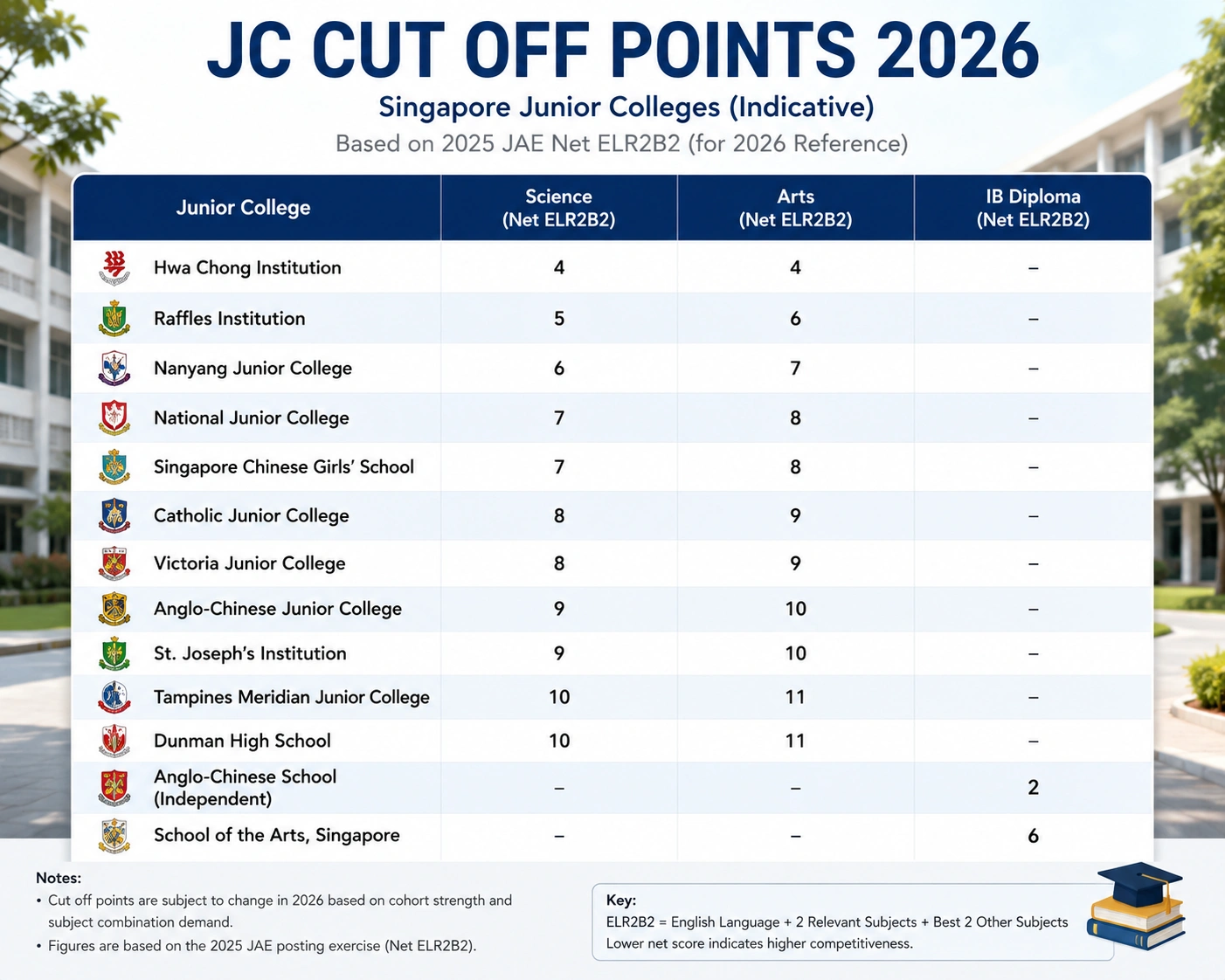
JC Cut Off Points 2026 give students a useful reference when deciding which junior colleges to include in their JAE choices. The figures are based on the net L1R5 aggregate score of students posted to each JC, so a lower score generally indicates stronger competition for that course. However, a COP is not a guaranteed admission score because the actual result depends on the applicants’ O-Level results and course choices each year.
For students comparing JCs in 2026, the cut-off points can help narrow down realistic choices based on their own L1R5 score. This guide covers the latest 2026 JC COPs, explains how L1R5 works, compares competitive JCs, and shows how to use these figures when making JAE choices

What Do the 2026 JC Cut Off Points Mean?
JC Cut Off Points (COP) refer to the net L1R5 aggregate score of the last student posted to a particular JC course through the Joint Admissions Exercise (JAE). For 2026, MOE lists these scores as the net aggregate range for each JC course. The figure gives students a practical idea of how competitive a course was during that year’s admission exercise.
What Does the Last Posted Student’s Score Mean?
The score represents the net L1R5 result of the last student who was posted to that course. It is not the average score of all students admitted. For example, if a JC course has a COP of 6, a student with a net L1R5 of 6 was within the score range of the final posted applicant for that course.
Why Does a Lower COP Mean Greater Competition?
A lower COP generally points to stronger demand. A JC with a COP of 3, for instance, admitted students with very strong net L1R5 scores, while a course with a higher COP had a wider admission range. Students should therefore compare their own score with the published range rather than looking at the school’s reputation alone.
Is the COP a Guaranteed Admission Score?
No. A COP should be treated as a reference point, not a guaranteed entry requirement. MOE states that actual net aggregate scores depend on the O-Level results and course choices of applicants in that year’s JAE. The final score can therefore move up or down from previous admission exercises.
Students should also remember that meeting a previous year’s COP does not automatically secure a place. Admission depends on the year’s competition, available vacancies, eligibility requirements and the choices submitted through JAE.
JC Cut Off Points 2026
The table below uses the 2026 JAE net L1R5 aggregate ranges published through MOE SchoolFinder. A lower starting point generally indicates a more competitive course, while the upper end shows the wider range of students posted to that course.
| Junior College | Science / IB | Arts | 2026 Competitiveness |
| Raffles Institution | 2–3 | 2–5 | Very High |
| Hwa Chong Institution | 2–4 | 2–5 | Very High |
| Eunoia Junior College | 2–5 | 2–6 | Very High |
| Nanyang Junior College | 2–5 | 2–7 | Very High |
| Anglo-Chinese Junior College | 2–7 | 4–9 | High |
| Dunman High School | 2–7 | 3–8 | High |
| Victoria Junior College | 2–6 | 3–8 | High |
| National Junior College | 3–7 | 5–8 | High |
| St. Andrew’s Junior College | 3–8 | 5–10 | Moderate–High |
| Temasek Junior College | 2–7 | 6–8 | Moderate–High |
| River Valley High School | 4–8 | 7–9 | Moderate |
| Anderson Serangoon Junior College | 5–10 | 7–11 | Moderate |
| Catholic Junior College | 6–11 | 5–12 | Moderate |
| Tampines Meridian Junior College | 6–12 | 9–13 | Moderate |
| Jurong Pioneer Junior College | 6–14 | 10–15 | Moderate |
| Yishun Innova Junior College | 7–18 | 5–19* | Wider Range |
*MOE notes that where vacancies remained after JAE posting, the displayed COP may be reflected as 20, even when the last student posted had a better score. This is particularly relevant when interpreting the lower-demand end of the table.
The Science / IB column combines Science courses with IB where applicable; for most JCs, the listed figure refers to the Science stream. Anglo-Chinese School (Independent) and St. Joseph’s Institution offer the IB programme rather than separate Arts and Science JAE courses, so they should be treated separately when comparing JC options. MOE’s 2026 course information confirms the programme structure.

Students should use these ranges as a planning reference, not as fixed admission requirements. The COP can change from one JAE to another depending on applicant results, choices and available places.
Which JCs Have the Lowest Cut Off Points in 2026?
The most competitive JCs in 2026 are Raffles Institution, Hwa Chong Institution, Eunoia Junior College and Nanyang Junior College, followed by National Junior College, Victoria Junior College and Dunman High School.
Raffles Institution & Hwa Chong Institution
Both have very low COPs, showing strong demand. Students need a strong net L1R5 score to be competitive for these JCs.
Eunoia & Nanyang Junior College
Eunoia and Nanyang also sit among the more competitive choices. Their COP ranges suggest that students with lower L1R5 scores generally have a stronger chance.
NJC, VJC & Dunman High
These JCs remain competitive but have slightly broader score ranges. They can give students with strong but not top-end L1R5 scores more options.
The key is to compare your net L1R5 with the full COP range, rather than treating one number as a guaranteed admission score. COPs can change each year based on applicant results, choices and available places.
Science vs Arts JC Cut Off Points 2026
Science and Arts can have different COPs within the same JC because students are posted to separate courses, and demand can vary between them. MOE’s 2026 SchoolFinder lists separate net L1R5 ranges for these courses where applicable.
For students choosing between the two, the COP should be used as a score reference, not the only reason to pick a stream. Compare your net L1R5 with the relevant Science or Arts range, then choose the course that matches the subjects you want to study.
A lower COP usually means the course was more competitive in that JAE. However, the actual score can change each year because it depends on applicants’ O-Level results and course choices.
How Is Your JC L1R5 Score Calculated?
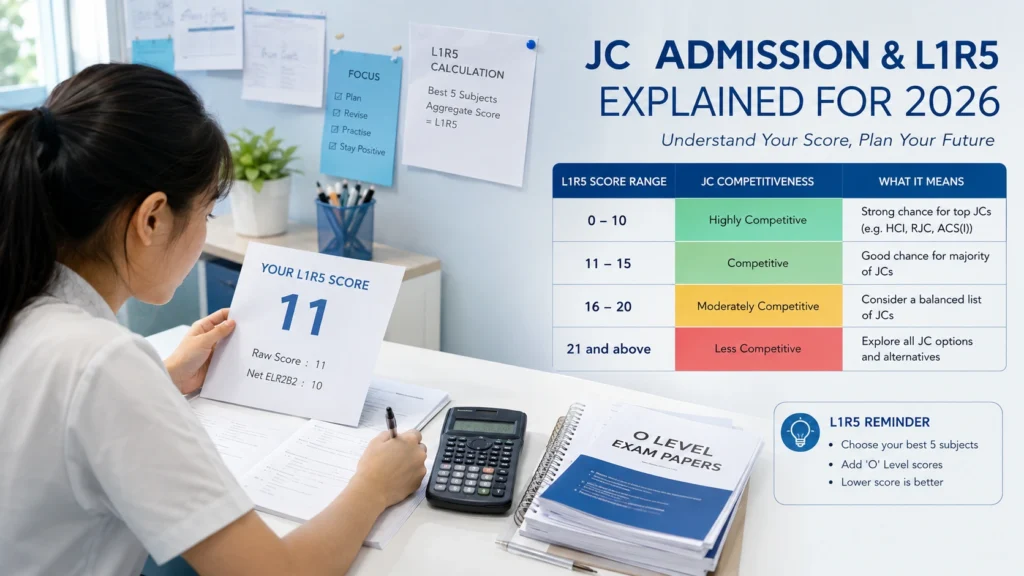
For students applying to JC in 2026, admission still uses the L1R5 system, which combines six O-Level subjects.
- L1: English Language or Higher Mother Tongue Language.
- R5: The five best eligible subjects, including the required subject groups.
- Bonus points: Eligible students can receive bonus points, which are deducted from the gross L1R5 score.
- Net L1R5: This is the final score used for JC posting. A lower net score is better.
For example, if a student’s gross L1R5 is 8 and they receive 2 bonus points, their net L1R5 becomes 6.
The current L1R5 system applies to the 2026 JAE. MOE plans to replace it with L1R4 from the 2028 JAE, reducing the admission calculation from six subjects to five.
Which JC Can You Aim for With Your L1R5?
Your net L1R5 can help you identify JCs that are realistic targets. Use the 2026 COP as a reference, not a guaranteed admission score.
- L1R5 3–5: Most competitive JCs, including RI, HCI, Eunoia and Nanyang.
- L1R5 6–8: Strong range of choices, including NJC, VJC, Dunman High and other established JCs.
- L1R5 9–12: Several JCs with broader COP ranges may be realistic options.
- L1R5 13–16: More accessible JC choices become available.
- L1R5 17–20: Students have a wider range of admission options, depending on course eligibility and vacancies.
If your score is close to a JC’s 2026 COP, avoid treating it as a safe choice. COPs can move each year based on applicant results, course demand and available places.:::
2025 vs 2026 JC Cut Off Points
Comparing the two years shows where competition changed. Some JCs kept the same COP, while others became more competitive in 2026. These figures are useful for spotting movement, but past COPs do not guarantee the next year’s result.
| JC | 2025 Science/IB | 2026 Science/IB | Change |
| Raffles Institution | 3 | 3 | No change |
| Hwa Chong Institution | 4 | 3 | 1 point lower |
| National Junior College | 7 | 6 | 1 point lower |
| Victoria Junior College | 6 | 6 | No change |
HCI and NJC became more competitive based on the lower COP, while RI and VJC remained unchanged. Students should use these changes as a guide when assessing their choices rather than treating them as fixed admission scores.
How to Choose a JC Using the 2026 COP
Use the 2026 COP as a starting point, then compare it with your net L1R5 to identify realistic choices. Check whether the JC offers your preferred subject combination, and look at its school culture, CCAs and academic programmes to see if they suit you. Travel distance also matters because a long daily commute can affect your study time and routine. A low COP shows strong competition, but it does not automatically make a JC the best choice
FAQs
What are the JC cut off points for 2026?
JC cut off points are the net L1R5 score ranges of students posted to each JC course through the 2026 JAE. The range differs by school and course.
Which JC has the lowest COP in 2026?
Raffles Institution and Hwa Chong Institution are among the most competitive JCs, with very low 2026 COPs. Eunoia and Nanyang JC also have highly competitive ranges.
Is a lower JC cut off point better?
A lower COP usually indicates stronger competition for that JC course. However, it does not automatically mean the school is the best choice for every student.
Can I enter a JC if my score is the same as its COP?
Matching the previous COP can make you competitive, but it does not guarantee admission. The COP may change depending on yearly demand, applicants’ results and available places.
How is L1R5 calculated for JC admission?
L1R5 combines L1 with five relevant subjects from your O-Level results. Eligible bonus points are deducted to calculate your net L1R5, with a lower score being better.
What is a good L1R5 score for JC?
A 3–5 can make highly competitive JCs realistic targets, while 6–12 opens up more established options. Your preferred course and the latest COP should also be considered.
Conclusion
JC Cut Off Points 2026 give students a useful benchmark for comparing junior colleges and judging how competitive different courses are. Your net L1R5 should be compared with the latest COP range, but it should not be treated as a guaranteed admission score. Use your result to create a balanced list of choices, including realistic options and a few ambitious ones. At the same time, check whether the JC offers your preferred subjects and programmes, has a suitable learning environment, and fits your daily travel routine. The right choice comes from combining your score, preferred course and personal fit, rather than choosing a school simply because it has the lowest COP.