
 By Global Arena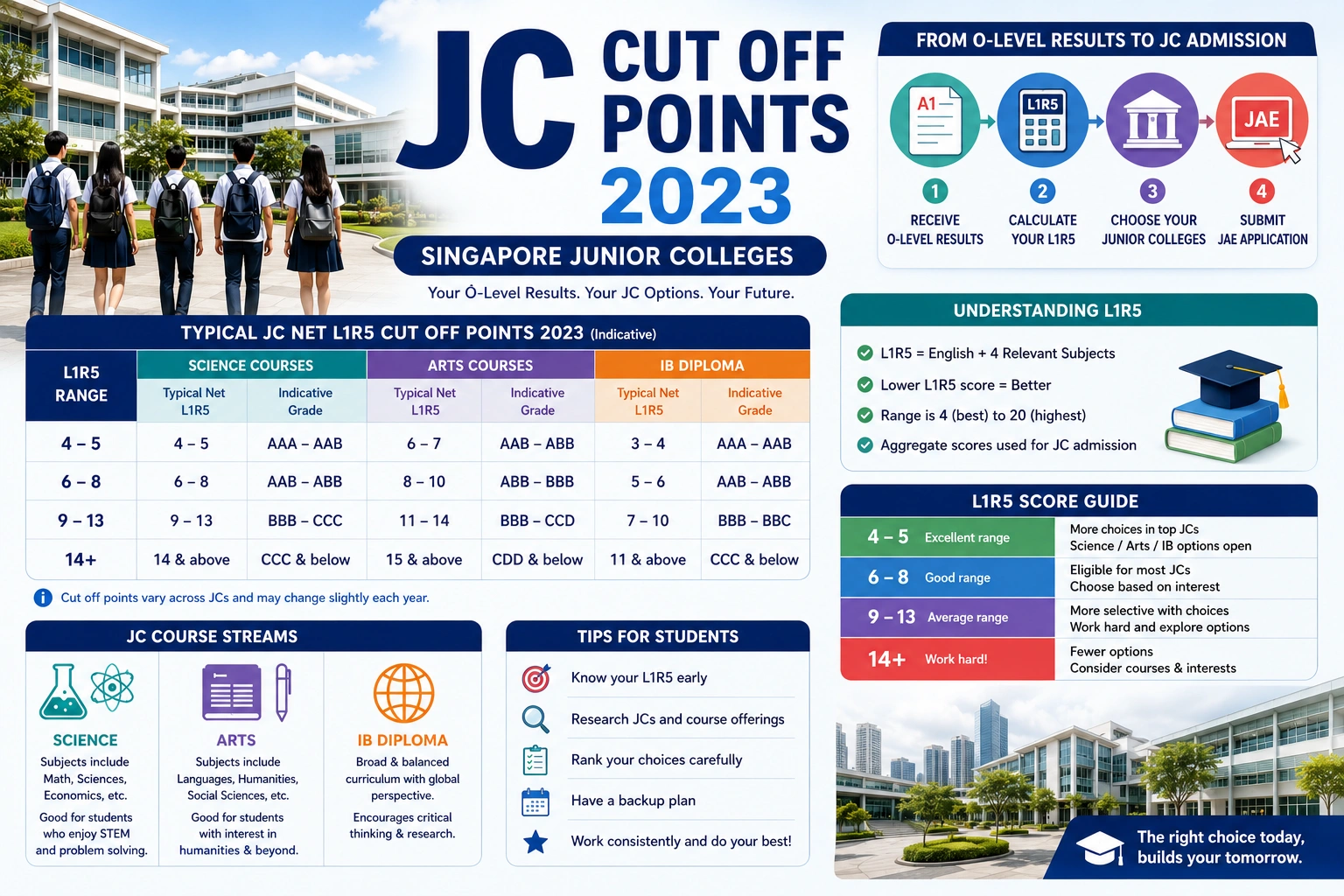
After receiving O-Level results, students often have one number in mind: their L1R5 score. The next question is where that score could have taken them.
The JC Cut Off Points 2023 give a useful look at admission competition across Singapore Junior Colleges during the 2023 intake. The published figures show the Net L1R5 score of the last student admitted to each course for that JAE exercise. For example, Hwa Chong Institution and Raffles Institution recorded a Science COP of 4, while Nanyang JC stood at 5.
These figures are useful for comparing schools, but they should not be treated as permanent entry requirements. JC cut-off points can change from one admission year to another as applicant scores, demand and available places change.

JC Cut Off Points 2023
Here is the main 2023 JAE comparison. The figures are based on the published Net L1R5 cut-off points for the respective courses.
| Junior College | Science / IB | Arts |
| Hwa Chong Institution | 4 | 5 |
| Raffles Institution | 4 | 5 |
| Anglo-Chinese School (Independent) | 5 | — |
| Nanyang JC | 5 | 6 |
| Eunoia JC | 6 | 8 |
| National JC | 7 | 8 |
| Victoria JC | 7 | 8 |
| St Joseph’s Institution | 7 | — |
| Anglo-Chinese JC | 8 | 9 |
| Dunman High School | 8 | 9 |
| River Valley High School | 8 | 9 |
| Temasek JC | 8 | 9 |
| St Andrew’s JC | 9 | 10 |
| Anderson Serangoon JC | 10 | 11 |
| Tampines Meridian JC | 13 | 13 |
| Catholic JC | 13 | 14 |
| Jurong Pioneer JC | 14 | 17 |
| Millenia Institute | 17 | 20 |
| Yishun Innova JC | 20 | 19 |
Note: Some institutions have different programme structures, so a dash does not mean that the school had no admission pathway. It means the particular Arts or Science figure is not listed in the same way.
What Does a JC Cut-Off Point Mean?
A JC cut-off point is easier to understand when you stop thinking of it as a fixed pass mark.
The COP represents the admission score at the lower end of the students accepted into a particular course during that JAE exercise. In simple terms, it gives you an idea of where the admission line ended that year.
For example, if a course recorded a COP of 8, students admitted to that course had Net L1R5 scores within the relevant admission range, with 8 representing the lowest score at the published cut-off.
This does not mean a student with exactly 8 points is guaranteed a place in another year.
The admission environment changes. If a school becomes more popular, more students with strong scores may place it high on their JAE choices. The following year’s COP could then move.
That is why historical COP data works best as a reference rather than a promise.
Also Read: Fastest MRT Routes in Singapore Without the Guesswork
Understanding L1R5 Before Comparing Your Score
The term L1R5 appears in almost every discussion about JC admission.
L1 refers to the student’s first language subject, while R1 to R5 represent five relevant subjects used in the aggregate.
The grade points are added together to produce the aggregate. Eligible bonus points can then affect the net score used for admission.
A smaller number is better.
So, a Net L1R5 of 6 is stronger than a Net L1R5 of 10.
This is also why you should be careful when comparing your O-Level result with an old COP table. Make sure you are comparing the same type of score. A raw aggregate and a net aggregate are not interchangeable.
The published 2023 JC figures are specifically presented as Net L1R5 scores.
Which JCs Had the Lowest Cut-Off Points in 2023?
The lowest Science COP in the 2023 table was 4, recorded by Hwa Chong Institution and Raffles Institution.
Both schools recorded 5 for Arts.
Nanyang JC followed with 5 for Science and 6 for Arts. Eunoia JC was next at 6 for Science and 8 for Arts. National JC and Victoria JC both recorded 7 for Science and 8 for Arts.
These numbers show that admission into the most competitive courses required a very strong Net L1R5.
But there is another point worth considering.
A low COP tells you that the course attracted strong competition. It does not tell you everything about the student experience. A student choosing between several schools should look beyond the number and compare subjects, CCAs, location, school environment and future plans.
That can matter just as much once you are actually studying there.
What Do the Middle-Range COPs Tell Students?
A large group of JCs sat between 8 and 11 for their 2023 Science and Arts figures.
Anglo-Chinese JC, Dunman High School, River Valley High School and Temasek JC each recorded 8 for Science and 9 for Arts. St Andrew’s JC followed with 9 for Science and 10 for Arts, while Anderson Serangoon JC recorded 10 and 11.
For students whose Net L1R5 falls around this range, the choice list becomes especially important.
You may have several possible schools rather than one obvious answer.
Instead of asking, “Which school has the lowest number?”, compare the actual programmes available.
For example, a student who already knows which subjects they want at A-Level may find one JC much more suitable than another despite a small difference in COP.
The same applies to travel time. A school that takes 30 minutes to reach may be a very different daily experience from one that takes over an hour.
JC Cut Off Points 2023: Science vs Arts
The difference between Science and Arts is another useful part of the 2023 data.
At many JCs, the Arts COP was one point higher than the Science COP. Hwa Chong and Raffles were 4 versus 5, Nanyang was 5 versus 6, and National and Victoria were 7 versus 8.
| Junior College | Science / IB | Arts | Difference |
| Hwa Chong Institution | 4 | 5 | 1 |
| Raffles Institution | 4 | 5 | 1 |
| Nanyang JC | 5 | 6 | 1 |
| Eunoia JC | 6 | 8 | 2 |
| National JC | 7 | 8 | 1 |
| Victoria JC | 7 | 8 | 1 |
| Anglo-Chinese JC | 8 | 9 | 1 |
| Dunman High School | 8 | 9 | 1 |
| River Valley High School | 8 | 9 | 1 |
| Temasek JC | 8 | 9 | 1 |
| St Andrew’s JC | 9 | 10 | 1 |
| Anderson Serangoon JC | 10 | 11 | 1 |
| Tampines Meridian JC | 13 | 13 | 0 |
| Catholic JC | 13 | 14 | 1 |
| Jurong Pioneer JC | 14 | 17 | 3 |
The figures do not mean that one stream is automatically harder or better. They simply show how the admission outcome differed between the two courses in 2023.
For students deciding between Arts and Science, the right choice should come from their subjects and interests rather than the COP alone.
What If Your L1R5 Was 5, 8, 10 or 13?
Looking at a COP table becomes more useful when you connect it to an actual score.
If your Net L1R5 was 5
The 2023 figures put you around the admission range of some of the most competitive JCs.
Hwa Chong and Raffles had a Science COP of 4 and Arts COP of 5, while Nanyang had 5 for Science and 6 for Arts. ACS (Independent) was also listed at 5 for its IB pathway.
That does not guarantee admission, but it gives you a clear idea of the level of competition.

If your Net L1R5 was 8
Your historical options would have been broader.
Eunoia, National and Victoria had Science COPs from 6 to 7 and Arts COPs of 8. Several other JCs recorded Science figures of 8 and Arts figures of 9.
This is the point where comparing individual schools becomes more useful than simply looking for the lowest COP.
If your Net L1R5 was 10
Anderson Serangoon recorded 10 for Science and 11 for Arts, while St Andrew’s stood at 9 and 10.
A student with this score would have had several schools to investigate, depending on the chosen course and eligibility.
If your Net L1R5 was 13
The 2023 figures included Tampines Meridian and Catholic JC at 13 for Science. Their Arts figures were 13 and 14 respectively.
Jurong Pioneer and Yishun Innova sat further up the numerical scale.
Again, these are historical comparisons rather than current admission guarantees.
Why Do JC Cut-Off Points Change?
A JC does not simply choose one permanent COP and keep it forever.
The final number is influenced by the students applying during that admission exercise.
Student demand
If more applicants prefer a particular JC, competition can become tighter.
Applicant scores
The academic profile of applicants changes every year. A different mix of scores can affect the final admission line.
Available places
The number of places available also matters. More competition for fewer places can affect the final result.
Course preference
Science and Arts may attract different groups of students, which helps explain why their COPs can differ.
JAE choices
Students rank their preferred institutions. Changes in those preferences can shift the admission pattern from one year to the next.
This is why a JC with a COP of 8 in one year could record 7 or 9 in another.
Should You Pick a JC Only Because Its COP Is Low?
No.
A low COP can show that a JC was highly competitive, but that does not automatically make it the right choice for every student.
Imagine that you have two options. One has a COP of 6 and another has a COP of 8.
The first school may look more attractive on paper. But suppose the second school offers the exact subject combination you want, has a shorter commute and has CCAs that match your interests.
In that situation, the second option may make more sense for you.
Your JC years are not just about getting through admission. You will spend two years studying, joining activities, preparing for examinations and making decisions about university.
The school needs to fit that experience.
COP Should Not Be Treated as a School Ranking
This is one of the easiest mistakes to make when searching for JC information.
A list arranged from 4 to 20 can look like a ranking of school quality.
It isn’t.
COP measures admission competitiveness. It does not directly measure teaching quality, student support, campus culture, university outcomes or how comfortable you will feel in the school.
If two JCs have COPs of 7 and 9, it is reasonable to say that the first had a more competitive admission outcome in that particular year.
It is not reasonable to conclude that every student will receive a better education there.
The distinction matters.
How to Build Your JAE Choices
A strong choice list should not depend on one school’s historical number.
Start by identifying the courses and subjects you actually want.
Then divide your options into three groups.
Ambitious choices
These are schools where your score is close to the historical COP.
Admission may be possible, but the previous number does not give you certainty.
Realistic choices
These are JCs where your score compares comfortably with the previous admission figure.
These should make up an important part of your list.
Safer choices
These give you additional protection if the admission line moves.
This approach is more sensible than putting all your choices into the same highly competitive group.
Don’t Forget the Subject Combination
Students sometimes choose a JC first and think about subjects later.
That can create problems.
Before putting a school high on your list, check the combinations it offers.
If you already have a university course in mind, work backwards.
For example, someone considering an engineering-related pathway may need a different subject combination from someone interested in humanities.
You don’t need to know your entire career at 16. But you should have enough direction to avoid choosing a school based purely on its COP.
Location Can Matter More Than You Expect
Singapore’s transport network makes many JCs accessible, but daily travel still adds up.
A 20-minute difference each way becomes a substantial amount of time across two years.
Think about your morning routine, lessons, CCAs and the time you need for revision.
If two schools are academically suitable and one gives you a much easier commute, that can be a real advantage.
Is the 2023 COP Still Useful?
Yes, particularly if your goal is to understand historical admission patterns.
The 2023 data shows a clear range across Singapore’s JCs and gives students a way to compare the competitiveness of different courses.
It can also help when looking at trends across multiple admission years. For example, several schools kept similar figures from 2022 to 2023, while others moved in one stream. Catholic JC’s Arts figure increased from 13 to 14, while Jurong Pioneer moved from 16 to 17 for Arts in the published tables.
But students applying in a later year should always check the newest available figures.
Historical COP is useful for context. Current admission information should guide current applications.

Also Read: Tuas West Road MRT Guide: Exit Information, Nearby Places
Common Mistakes Students Make With JC COP
Mistake 1: Treating the COP as guaranteed
If your score matches an old COP, don’t assume you are automatically admitted.
Mistake 2: Choosing only the most competitive schools
A choice list needs some balance.
Mistake 3: Ignoring course requirements
Your preferred subjects should be checked before you rank a school.
Mistake 4: Using COP as a school-quality ranking
Admission competitiveness and educational fit are different things.
Mistake 5: Looking at only one year
A single year’s figure can be unusual. Comparing several years gives better context.
FAQs About JC Cut Off Points 2023
What was the lowest Science COP in 2023?
Hwa Chong Institution and Raffles Institution both recorded a Science COP of 4.
What was the lowest Arts COP in 2023?
Hwa Chong Institution and Raffles Institution both recorded an Arts COP of 5.
What was Nanyang JC’s COP in 2023?
Nanyang JC recorded 5 for Science and 6 for Arts.
What was Eunoia JC’s COP?
Eunoia JC recorded 6 for Science and 8 for Arts in the 2023 figures.
What was the COP for Jurong Pioneer JC?
Jurong Pioneer JC recorded 14 for Science and 17 for Arts.
What was Yishun Innova JC’s COP?
Yishun Innova JC was listed at 20 for Science and 19 for Arts in the 2023 figures.
Does a lower COP mean a better JC?
Not necessarily. It indicates stronger admission competition for that course in that year, but it does not measure every aspect of the school.
Can COP change every year?
Yes. Student demand, applicant scores, available places and JAE choices can all affect the final admission figure.
Can I use the 2023 COP to predict my admission?
It can give you a historical reference point, but it cannot guarantee admission in another year.
Final Thoughts
The JC Cut Off Points 2023 are useful because they turn a vague question — “Which JC can I get into?” — into something easier to compare.
The numbers show a wide admission range. Hwa Chong Institution and Raffles Institution were at the most competitive end with a Science COP of 4, while several other JCs had figures in the 8–14 range and Yishun Innova reached 20 for Science.
But your decision should not stop at the number.
Start with your Net L1R5, then consider the course you want, available subjects, school environment, CCAs and travel time. Build a JAE list with ambitious, realistic and safer options rather than relying on one historical COP.
Most importantly, remember what the figure actually represents. It is a snapshot of one admission exercise, not a permanent label attached to a school.
That makes the 2023 COP data useful — not because it can predict your future exactly, but because it gives you a clearer picture of how JC admission competition looked at that time.